

Active Learning Guide Fparentips: Simple Ways to Help Children Learn
Discover how the Active Learning Guide Fparentips helps parents build children's confidence, curiosity, creativity, and problem-solving skills through everyday activities.

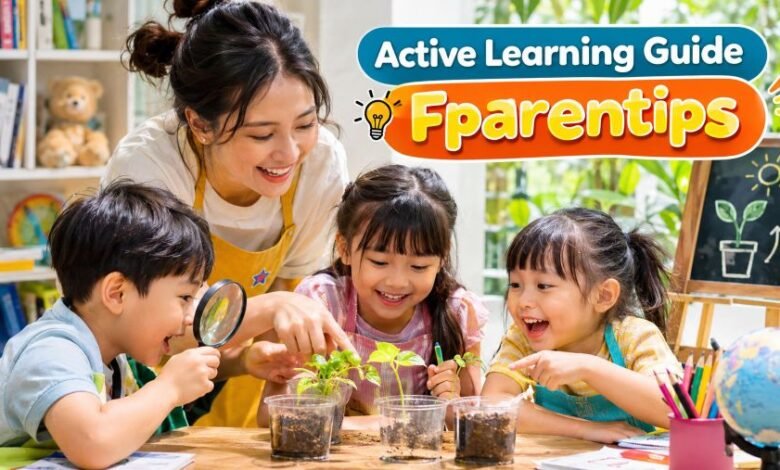
Introduction
Children learn in many ways. Some enjoy reading books, while others prefer building things, asking questions, or discovering something new through play.
The Active Learning Guide Fparentips introduces a practical approach that encourages children to become involved in their own learning instead of simply listening to instructions.
Parents do not need expensive learning equipment or special teaching qualifications. Simple activities at home can help children practise useful skills.
From cooking and storytelling to outdoor games and small science experiments, learning opportunities are everywhere.
This article explains what the Fparentips guide covers, how active learning works, and how families can introduce these ideas into daily life.
Quick Facts About Active Learning Guide Fparentips
| Feature | Details |
|---|---|
| Guide name | Active Learning Guide Fparentips |
| Website | Fparentips.com |
| Credited author | Selvian Velmyre |
| Main topic | Active learning for children |
| Intended audience | Parents, caregivers, and families |
| Learning approach | Play, discovery, participation, and problem-solving |
| Age groups covered | Toddlers, preschoolers, and school-age children |
| Main activities | Reading, building, cooking, sorting, and experiments |
| Materials required | Mostly ordinary household items |
| Main purpose | Supporting children’s learning and development |
What Is Active Learning Guide Fparentips?
Active Learning Guide Fparentips is an online parenting article that explains how children can learn through direct participation in everyday activities.
Its main idea is simple: children should have opportunities to think, try, question, and discover rather than only receive information.
For example, a child learning about plants could read about how seeds grow.
That is useful.
But planting a seed, watering it, watching its growth, and talking about the changes creates another opportunity to understand the subject.
The guide encourages this kind of practical experience.
It also suggests that parents act as learning partners. Instead of immediately providing every answer, they can ask questions and help children find solutions.
Fparentips is an informational parenting resource, not a formal school curriculum or professional educational assessment.
Why Active Learning Matters for Children
Active learning gives children opportunities to practise skills while doing something meaningful.
It can support several areas of development.
1. Encourages Independent Thinking
Children often become curious when they encounter something unfamiliar.
Allowing them to investigate helps them practise making decisions and considering different possibilities.
A child building a block tower, for instance, might discover that a wider base makes the structure more stable.
That simple discovery introduces ideas about balance.
2. Supports Problem-Solving Skills
Not every activity works on the first attempt.
A puzzle may seem difficult. A paper aeroplane may not fly properly. A building made from blocks might collapse.
These experiences create opportunities to identify problems and try alternative solutions.
Parents can offer hints when needed without completing every task for the child.
3. Builds Communication Skills
Conversation plays an important part in learning.
When parents ask children to explain what they are making or why something happened, children practise expressing their thoughts.
Storytelling, shared reading, and discussions can also introduce new vocabulary.
4. Encourages Creativity
Open-ended activities allow children to make their own choices.
Drawing a picture, inventing a story, or making something from cardboard gives them freedom to experiment with ideas.
There is no need for every activity to produce a perfect result.
5. Provides Opportunities for Confidence
Completing a challenge can give children a sense of achievement.
Even when they need assistance, understanding how they made progress can encourage them to try again.
Parents can recognise effort, improvement, and thoughtful decisions rather than focusing only on correct answers.
How Parents Can Use Active Learning at Home
The Fparentips approach does not require a classroom-style learning area.
A few changes to ordinary family routines can make learning more interactive.
Create a Comfortable Learning Space
Choose a safe and accessible area where children can read, draw, build, or play.
Keep a few suitable materials nearby, such as books, paper, colouring pencils, and building blocks.
The space does not need to be large.
What matters is that children can participate comfortably and that materials are appropriate for their age.
Ask Questions That Encourage Thinking
Rather than asking only questions with one correct answer, try questions that invite explanation.
For example:
- What do you think will happen next?
- Why do you think that worked?
- Can you find another way?
- What would you change?
- How did you solve that problem?
Give children enough time to respond.
Sometimes they need a quiet moment to organise their ideas.
Let Children Make Choices
Offer a small selection of activities and allow children to choose.
One child may want to paint, while another prefers building or reading.
Having some control over an activity can help children become more involved.
Parents can still provide guidance and introduce useful learning goals.
Connect Learning With Real Life
Ordinary household tasks provide plenty of opportunities.
During cooking, children can count ingredients or compare measurements.
While organising toys, they can sort objects by size, shape, or colour.
Shopping can introduce counting, prices, and making choices.
These experiences help children connect ideas with situations they recognise.
Active Learning Activities for Different Age Groups
Children develop at different rates, so activities should suit their abilities, interests, and safety needs.
Toddlers: Ages 1–3
Toddlers often learn through movement, observation, repetition, and sensory experiences.
Suitable activities include:
- Stacking large blocks
- Looking at picture books
- Naming everyday objects
- Sorting large, safe toys by colour
- Playing simple imitation games
An adult should supervise activities and avoid small objects that could cause choking.
Preschoolers: Ages 3–5
Preschool children can begin taking part in more detailed activities that involve making predictions and explaining ideas.
Try:
- Planting seeds
- Playing simple matching games
- Building with blocks
- Retelling familiar stories
- Making drawings and explaining them
- Testing which safe objects float or sink
For example, a parent might ask a child to predict whether a plastic toy will float in water.
After testing the idea, they can discuss the result.
School-Age Children: Ages 6–9
Older children can take on projects involving several steps.
Activities might include:
- Reading recipes and measuring ingredients
- Creating a simple household budget
- Designing paper aeroplanes
- Making a weather observation diary
- Solving age-appropriate puzzles
- Researching an animal or planet
- Planning a short family outing
These activities provide opportunities to practise reading, maths, planning, and reasoning.
A Simple Seven-Day Active Learning Plan
Parents who want to introduce active learning can begin with a short weekly routine.
| Day | Activity | Learning focus |
|---|---|---|
| Monday | Read and discuss a story | Language and comprehension |
| Tuesday | Build with blocks or boxes | Planning and problem-solving |
| Wednesday | Cook or prepare a snack together | Counting and measurement |
| Thursday | Observe plants or insects outdoors | Science and observation |
| Friday | Draw or create a handmade object | Creativity and fine motor skills |
| Saturday | Play a puzzle or board game | Reasoning and cooperation |
| Sunday | Talk about the week’s discoveries | Reflection and communication |
These activities can be shortened, extended, or replaced according to the child’s needs.
Even a few focused minutes can provide an opportunity for meaningful interaction.
Active Learning Through Games and Play
Play is not separate from learning.
Children can practise communication, cooperation, planning, and decision-making while playing games.
For instance, building a pretend shop can involve counting items, choosing prices, speaking with customers, and taking turns.
A treasure hunt can involve following directions, observing surroundings, and remembering clues.
The American Academy of Pediatrics recognises the value of developmentally appropriate play for children’s cognitive, language, social, and emotional development.
However, active learning does not mean removing structured teaching.
Children can benefit from both clear instruction and opportunities to practise ideas through play.
Can Technology Support Active Learning?
Digital tools can be useful when they encourage children to think and participate.
Examples include age-appropriate educational games, drawing applications, interactive stories, and creative activities.
A child watching a video about space could follow it by drawing the planets or discussing what they learned.
That adds an active element to the experience.
Parents should consider the child’s age, the quality of the content, privacy, and screen-time recommendations.
Technology should complement rather than replace physical play, conversation, rest, and face-to-face interaction.
Common Mistakes Parents Should Avoid
Active learning works best when activities remain enjoyable and suitable for the child.
Giving answers too quickly: Children may benefit from time to think before receiving help.
Making every activity competitive: The aim is understanding and participation, not always finishing first.
Expecting perfect results: Mistakes can lead to useful conversations and new attempts.
Choosing tasks that are too difficult: Activities should offer manageable challenges, with help when needed.
Following a strict schedule: Some days children may be tired or uninterested. A flexible routine is often more practical.
Comparing children: Each child develops differently. Observe individual progress rather than expecting everyone to learn at the same pace.
How Can Parents Measure Learning Progress?
Parents do not need formal tests to notice everyday learning.
They can observe whether a child is beginning to ask more detailed questions, explain decisions, use new words, or complete tasks with less assistance.
A simple notebook can help.
Write down what activity the child tried, what they found interesting, and which parts required help.
After several weeks, review the notes.
The aim is to understand how the child is progressing, not assign a score to every activity.
For concerns about learning or development, parents should seek guidance from a qualified teacher, paediatrician, or appropriate specialist.
Is Active Learning Guide Fparentips Reliable?
Fparentips provides practical ideas for parents who want to encourage learning through family activities.
Many of its general principles are consistent with established approaches to play-based and guided learning.
For example, the National Association for the Education of Young Children supports developmentally appropriate, play-based learning.
The Education Endowment Foundation also recognises the value of parental involvement and practical support for learning at home.
Still, parents should distinguish general suggestions from claims proven by scientific studies.
A parenting article may provide useful activity ideas without independently demonstrating that its particular methods improve academic results.
Fparentips is best treated as a starting point for family activities rather than a replacement for professional educational guidance.
Final Thought
The Active Learning Guide Fparentips offers a simple message: children can learn from the ordinary experiences happening around them.
Building a tower, preparing food, reading a story, or observing nature can become an opportunity to practise valuable skills.
Parents do not need to organise complicated lessons every day.
Start with one small activity. Ask thoughtful questions. Offer help when necessary, and give children room to experiment.
Learning can happen in simple moments.
Frequently Asked Questions (FAQs)
1. What is Active Learning Guide Fparentips?
It is a parenting article published on Fparentips.com that shares practical ways to encourage children’s learning through play, exploration, everyday activities, and problem-solving.
2. Is Fparentips suitable for young children?
The guide includes activity ideas for toddlers, preschoolers, and children aged approximately six to nine. Parents should adapt activities to their child’s development and safety needs.
3. What are the main benefits of active learning?
Active learning can provide opportunities for children to practise thinking, communication, creativity, cooperation, and problem-solving.
4. Do parents need expensive educational materials?
No. Books, blocks, paper, household objects, and suitable outdoor activities can all support practical learning.
5. Can active learning help with schoolwork?
It can help children practise ideas they encounter at school. Reading together, measuring ingredients, and solving puzzles are examples of activities that can reinforce learning.
6. How much time should parents spend on active learning?
There is no single required duration. Short, regular activities that suit the child’s age, attention, and family routine are a practical starting point.
7. Is Fparentips a professional education programme?
No formal accreditation or structured school curriculum is presented for the Fparentips article. It should be regarded as general parenting guidance.
8. Can parents use active learning with children who have different learning needs?
Yes. Activities can be adjusted using different materials, communication methods, levels of support, and participation options. Individual advice from educators or specialists may also be helpful.