

Research Dossier for a Target Company: What Should You Check Before You Trust a Business?
A practical way to research a company’s ownership, finances, leadership, competitors, reputation, and risks before making an important decision

Introduction
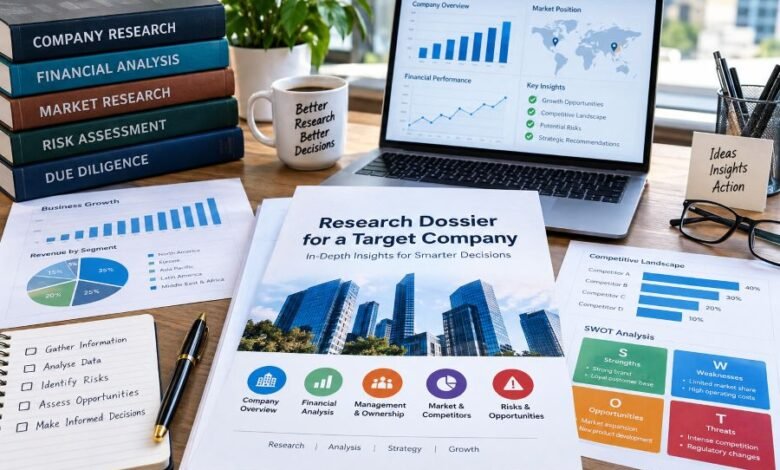
A Research Dossier for a Target Company is a structured report that brings important information about one business into a single document.
It is more than a company profile.
A basic profile may tell you when a business started, where it operates, and what it sells. A proper research dossier goes further. It checks how the company makes money, who controls it, how it is performing, what risks surround it, and whether important claims can be supported by reliable evidence.
That makes the dossier useful before an investment, partnership, supplier agreement, sales approach, acquisition, competitor review, or major commercial decision.
Quick Facts
| Topic | Details |
|---|---|
| Main purpose | Organize verified information about a company |
| Common users | Investors, businesses, consultants, sales teams, researchers |
| Main areas | Ownership, finances, management, products, market, risks |
| Best sources | Regulatory filings, company accounts, official registries, court or enforcement records |
| Key rule | Separate confirmed facts from estimates and opinions |
| Update frequency | Whenever important financial, ownership, leadership, or legal information changes |
What Is a Research Dossier for a Target Company?
A Research Dossier for a Target Company is a detailed collection of facts, supporting evidence, and business analysis about a company selected for research.
Here, “target company” simply means the company you are investigating. It does not automatically mean Target Corporation, the American retailer.
The document may cover:
- company identity and registration
- ownership
- directors and senior management
- products and services
- customers
- revenue model
- financial results
- employees and locations
- competitors
- market position
- recent developments
- legal or regulatory issues
- reputation
- business risks
The exact depth should depend on why you are doing the research.
A salesperson preparing for a meeting may need a shorter dossier. Someone examining a possible acquisition may require considerably more financial, contractual, tax, legal, and operational evidence.
Why Create a Company Research Dossier?
Online research can become messy very quickly.
You may find the company history on its website, revenue figures inside an annual report, directors in a corporate register, customer complaints on review platforms, and legal information somewhere else entirely.
A dossier gives those findings a home.
It also makes one important distinction: a claim is not the same as verified evidence.
A company can describe itself as a market leader. That is a corporate claim unless market data supports it.
A website can display an employee number. That figure becomes far more useful when you know when it was published and whether another credible source supports it.
Good company research records both the information and its source.
Start With a Clear Research Objective
Do not begin by collecting every fact you can find.
First decide what you need to know.
For example:
Target company: Example Ltd
Research date: September 2026
Objective: Assess the company’s business model, ownership, financial position, competitors, and major commercial risks.
Your questions might include:
- What does the company sell?
- Who owns it?
- Who runs it?
- Where does its revenue come from?
- Is revenue growing or falling?
- Does it rely heavily on one product or customer?
- Who are its closest competitors?
- Has the business faced material legal or regulatory problems?
- Has management changed recently?
- What could affect future performance?
These questions keep the research focused.
1. Confirm the Company’s Identity
This sounds basic. It is not.
Businesses can have similar names, subsidiaries, trading names, former names, and different legal entities in different countries.
Record:
- legal company name
- trading name
- registration number
- incorporation date
- registered office
- headquarters
- official website
- industry
- operating countries
- parent company, if applicable
- major subsidiaries
For UK businesses, Companies House provides public access to company details including incorporation information, officers, document images, charges, previous names, and insolvency information.
One caution matters: information appearing in a public register should still be read carefully and cross-checked where the decision is significant.
2. Study Ownership and Control
Next, find out who controls the company.
Look for:
- founders
- parent company
- major shareholders
- institutional ownership
- private-equity ownership
- persons with significant control
- recent ownership changes
- acquisitions or disposals
Ownership matters because it can affect strategy, financing, leadership, and risk.
For a private business, ownership information may be limited. Do not fill gaps with guesses.
Mark information clearly as confirmed, estimated, or unverified.
3. Review Leadership
Research the people making major decisions.
Useful details include:
- chief executive
- finance director or CFO
- board members
- founders
- operating executives
- recent appointments
- recent departures
Then check whether management has changed repeatedly.
One resignation does not prove there is a problem. Several senior departures within a short period, however, may justify further investigation.
Context matters.
Avoid making assumptions about motive unless there is strong public evidence.
4. Understand How the Company Makes Money
This is one of the most important parts of a Research Dossier for a Target Company.
Ask:
What is the business actually selling, and who pays for it?
Identify:
- main products
- services
- customer groups
- geographic markets
- pricing model
- sales channels
- subscription revenue
- recurring revenue
- licensing income
- advertising revenue
- transaction fees
- retail or wholesale sales
Then look for concentration.
If most revenue comes from one product, market, or customer, that dependence deserves attention.
A business can look large while still being exposed to a narrow revenue base.
5. Check Financial Performance
For public companies, financial statements are often one of the strongest evidence sources.
In the United States, the SEC’s EDGAR system provides free public access to millions of company filings, including periodic reports, registration statements, financial information, and other disclosures.
Review figures such as:
| Financial Area | What to Check |
|---|---|
| Revenue | Is it increasing or decreasing? |
| Profit | Is the business actually profitable? |
| Operating margin | Are core operations improving? |
| Cash flow | Is cash generation healthy? |
| Debt | How much does the company owe? |
| Cash reserves | What financial cushion exists? |
| Assets | What valuable resources does it control? |
| Liabilities | What obligations may create pressure? |
Never quote a financial number without its reporting period.
Instead of writing:
“Revenue is £50 million.”
Write:
“The company reported revenue of £50 million for the financial year ending March 2026.”
The date changes the meaning.
6. Look Beyond Revenue
Revenue gets attention, but it cannot tell the whole story.
Imagine a company whose sales rose from £20 million to £30 million.
That sounds positive.
But what if:
- losses doubled?
- debt increased sharply?
- customer acquisition costs surged?
- one client generated half the sales?
- operating cash flow turned negative?
That is why the dossier should connect numbers rather than copying them separately.
Look for patterns.
7. Examine Products and Services
List the company’s main offers.
Then ask:
- Which products appear most important?
- Which are new?
- Which may be declining?
- Does the company depend on one flagship product?
- Are prices public?
- Does the business serve consumers or other businesses?
- Has it recently entered a new category?
Product information from a company website is useful for understanding what it sells, but promotional statements should not automatically be treated as independent evidence.
8. Identify Major Competitors
A company makes more sense when viewed beside its alternatives.
Create a small competitor comparison.
| Area | Target Company | Competitor A | Competitor B |
|---|---|---|---|
| Main market | |||
| Core product | |||
| Customer type | |||
| Pricing position | |||
| Geographic reach | |||
| Main difference |
Do not automatically assume that the largest company in an industry is the closest competitor.
The most useful comparison is usually with companies serving similar customers with similar products.
9. Research the Market
Next, widen the view.
Consider:
- market size
- industry growth
- consumer demand
- technology changes
- regulation
- supply-chain conditions
- new competitors
- economic pressures
- customer behaviour
This helps explain why company results may be changing.
For example, falling sales may reflect poor execution. Or the entire industry may be contracting.
Those are very different conclusions.
10. Check Legal and Regulatory History
This section requires careful language.
Look for public records involving:
- lawsuits
- regulatory action
- fines
- investigations
- insolvency
- director disqualification
- intellectual-property disputes
- consumer-protection cases
- environmental action
For U.S. research, the Department of Justice maintains public corporate enforcement and corporate-crime records that can help identify certain federal enforcement matters.
Do not treat an allegation as a proven fact.
Clearly distinguish among:
alleged, charged, settled, found liable, and convicted.
Those terms are not interchangeable.
11. Review Reputation Carefully
Reputation research can provide useful signals, but it is easy to misuse.
Sources may include:
- customer reviews
- employee reviews
- major news reports
- trade publications
- consumer complaints
- industry forums
Do not base a conclusion on one angry review.
Look for repeated themes across many independent sources.
For example, repeated customer complaints about delivery delays may justify further checking. A single complaint generally does not.
12. Track Recent Company Developments
Add a short timeline covering significant events.
These could include:
- acquisitions
- funding rounds
- new product launches
- leadership changes
- market exits
- office closures
- layoffs
- partnerships
- lawsuits
- regulatory decisions
- major contracts
- new locations
Dates are important.
Company information can become outdated surprisingly quickly.
A Simple Research Dossier Template
You can use the following structure for almost any business:
Company Identification
Legal name:
Website:
Registration number:
Founded:
Headquarters:
Industry:
Research Objective
Why is the company being researched?
Executive Summary
Write the main findings in a few short paragraphs.
Ownership
Who owns or controls the business?
Leadership
Who are the key decision-makers?
Business Model
How does the company earn money?
Products and Services
What does it sell?
Financial Performance
Record revenue, profits, losses, cash flow, debt, and relevant trends.
Customers
Who buys from the company?
Competitors
Who provides comparable products or services?
Market Position
Where does the company sit within its industry?
Recent Developments
What has changed recently?
Legal and Regulatory Review
Are there material public cases or regulatory matters?
Risks
What issues could affect the company?
Evidence Log
For every major claim, record:
- source
- publication date
- reporting period
- date accessed
- confidence level
Use an Evidence Rating System
A simple rating system helps prevent weak claims from appearing equal to strong ones.
Confirmed: Supported directly by an official or primary source.
Corroborated: Supported by several credible independent sources.
Estimated: Based on third-party analysis rather than official disclosure.
Claimed: Stated by the company but not independently confirmed.
Unverified: Found online but lacking enough evidence.
This small step can make the dossier much more useful.
Primary Sources Should Come First
When possible, start with:
- annual reports
- regulatory filings
- official company registries
- audited accounts
- investor-relations pages
- official press releases
- court documents
- government enforcement databases
- patent and trademark databases
Then use credible secondary reporting to add context.
For UK company research, Companies House states that its public company-information service is available free of charge and includes basic company data, business classifications, status information, and filings.
For U.S. public companies, SEC EDGAR should usually be one of the first financial and regulatory sources checked.
Common Mistakes to Avoid
Copying the Company Website
A corporate website is useful, but it represents the company’s own presentation of itself.
Treat marketing claims accordingly.
Using Old Numbers
Revenue, employee numbers, locations, executives, and ownership can change.
Always attach dates.
Trusting One Source
Important claims should be checked against primary evidence or multiple credible sources.
Mixing Companies With Similar Names
Confirm legal identity before recording information.
Turning Rumours Into Facts
Do not include unsupported claims simply because they appear in search results or social posts.
Collecting Too Much Information
A 100-page dossier is not automatically better than a 15-page one.
Keep evidence that helps answer the research objective.
How Long Should a Company Dossier Be?
There is no fixed length.
A short pre-sales dossier might be three to five pages.
A competitor research document could run longer.
An acquisition-related dossier may become extensive because finance, tax, legal, operations, technology, employment, contracts, and regulatory matters may each require separate review.
Depth should match risk.
The more important the decision, the stronger the verification process should be.
Can AI Be Used to Build a Research Dossier?
AI can help with:
- organizing notes
- summarizing filings
- comparing competitors
- extracting repeated themes
- building research questions
- formatting timelines
- identifying gaps
It should not become the source of truth.
Important company facts should still be checked against the underlying source, especially financial, legal, ownership, and regulatory information.
A polished answer with a wrong figure is still wrong.
Final Thought
A Research Dossier for a Target Company works best when it answers three simple questions:
What do we know?
Where did that information come from?
Why does it matter?
That is the difference between collecting search results and doing useful company research.
Start with the correct legal entity. Use primary sources first. Add dates to changing figures. Separate company claims from independently supported facts. Most importantly, leave uncertain information marked as uncertain rather than filling gaps with assumptions.
The finished dossier should give the reader a clear, evidence-based picture of the business and show exactly where further investigation may be needed.
Frequently Asked Questions
What is a Research Dossier for a Target Company?
It is a structured report containing verified information and analysis about a company, including its ownership, leadership, business model, finances, competitors, market position, and risks.
Does “target company” mean Target Corporation?
No. In this context, a target company is simply the business selected for research.
What should be included in a target company dossier?
Common sections include company identity, ownership, management, finances, products, customers, competitors, market information, recent developments, legal matters, risks, and source records.
Where can I find reliable company information?
Good starting points include official company registries, regulatory filings, annual reports, government databases, investor-relations pages, and credible financial or business publications.
How do I research a private company?
Start with corporate registries, official websites, accounts where publicly filed, ownership records, press releases, regulatory databases, industry publications, and credible news sources. Private companies usually disclose less financial information than public companies.
How often should a research dossier be updated?
Update it when new financial results, leadership changes, acquisitions, ownership changes, regulatory matters, major contracts, or other significant company developments occur.
Is a company research dossier the same as due diligence?
Not exactly. A research dossier organizes information and analysis. Formal due diligence may involve deeper legal, financial, tax, technical, and contractual checks carried out by qualified professionals.
What is the most important rule when researching a company?
Verify major claims. Record the source and date, and clearly mark information that remains estimated or unconfirmed.