

Air France A350 Chicago Flight Return: Why AF136 Turned Back to Paris
Air France Flight AF136 was heading from Paris to Chicago when its Airbus A350 unexpectedly reversed course over the Atlantic. Here is what happened, why the aircraft returned, and what passengers experienced.

Introduction
The Air France A350 Chicago Flight Return became an unusual aviation story after a long-haul flight headed for the United States changed direction while already several hours into its journey.
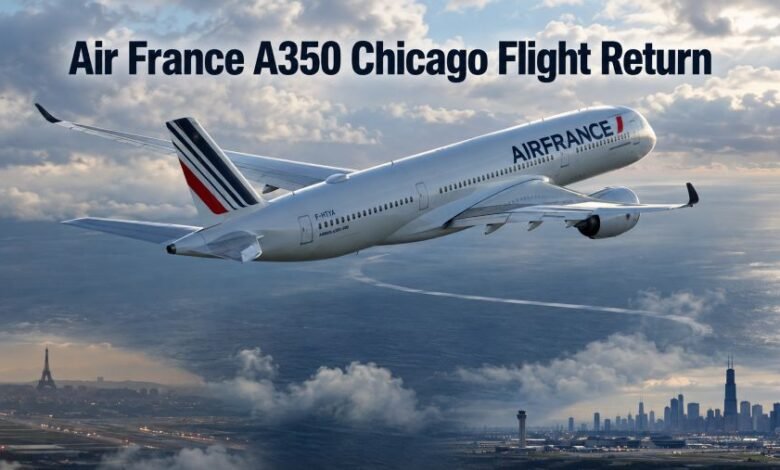
Air France Flight AF136 departed Paris-Charles de Gaulle Airport for Chicago O’Hare International Airport on June 28, 2025. Instead of continuing to Chicago, the Airbus A350-900 turned around over the North Atlantic and headed back to France.
The aircraft landed safely in Paris. Reports linked the decision to an operational issue involving authorization to land in Chicago rather than a confirmed mechanical problem with the A350.
Quick Facts
| Detail | Information |
|---|---|
| Flight number | Air France AF136 |
| Date | June 28, 2025 |
| Aircraft | Airbus A350-900 |
| Registration | F-HUVR |
| Departure airport | Paris-Charles de Gaulle |
| Destination | Chicago O’Hare |
| Departure time | Around 12:49 CEST |
| Cruising altitude | Around 38,000 feet |
| Result | Returned safely to Paris |
| Total flight duration | About 6 hours 37 minutes |
| Reported reason | Operational / clearance issue |
What Happened to Air France Flight AF136?
Flight AF136 began as a normal transatlantic service from Paris to Chicago.
The Airbus A350-900 left Paris-Charles de Gaulle at approximately 12:49 CEST. It departed from Terminal 2E, took off from runway 26R and climbed to around 38,000 feet.
The aircraft followed its expected route over the United Kingdom and continued toward the North Atlantic.
Everything appeared routine at first.
Then the situation changed.
At around 16:30 CEST, while the A350 was over the Atlantic between Iceland and Greenland, the crew turned the aircraft around.
Instead of continuing west toward Chicago, AF136 began flying east again toward France.
The aircraft eventually landed safely back at Paris-Charles de Gaulle on runway 27R. By that point, it had been flying for approximately 6 hours and 37 minutes.
Why Did the Air France A350 Chicago Flight Return Happen?
The biggest question is simple: why would an aircraft already well into a transatlantic flight return to its original airport?
Air France reportedly described the reason as an operational issue.
A passenger who contacted aviation news outlet AIRLIVE was reportedly told that the flight had not received the necessary authorization to land in Chicago.
That has led to the incident being widely described as a clearance or landing-authorization issue.
However, there is an important distinction.
Public reporting has not established every administrative detail behind the incident. It would therefore be inaccurate to claim with certainty that one specific document, customs form or deadline caused the return.
The safest conclusion is that an operational clearance issue prevented the flight from continuing normally to Chicago.
Was There a Problem With the Airbus A350?
There is no confirmed evidence that the aircraft suffered a major technical failure.
Reports surrounding AF136 did not identify an engine failure, cabin-pressure emergency, fire or other serious mechanical problem as the reason for the return.
That matters because the dramatic change in direction could easily make people assume that something was wrong with the aircraft itself.
Available information points elsewhere.
The flight appears to have returned because of an operational or authorization issue connected with reaching Chicago rather than because the A350 was unable to continue flying safely.
Which Airbus A350 Was Involved?
The aircraft operating Flight AF136 was an Airbus A350-900 registered F-HUVR.
The A350-900 is a long-range wide-body aircraft designed for international routes such as Paris to Chicago.
Its involvement does not suggest that the aircraft type itself caused the incident.
The jet flew normally back across the Atlantic and landed safely in Paris.
Where Did AF136 Turn Around?
AF136 had already travelled a substantial distance before returning.
Reports place the turnaround over the North Atlantic, broadly between Iceland and Greenland.
At that stage, the aircraft was already roughly halfway through its journey between Paris and Chicago.
This makes the decision particularly interesting.
Turning around meant spending several additional hours in the air and eventually bringing passengers back to the same city from which they had departed.
Still, airlines have to consider more than simple distance.
Airport authorization, border requirements, ground handling, passenger processing, crew working limits, fuel planning and airline support facilities can all affect the decision.
Why Didn’t AF136 Divert to Another US Airport?
At first glance, diverting to another American airport may seem easier than flying all the way back to Paris.
International aviation does not always work that way.
If an operational issue concerns entry authorization, customs processing or another regulatory requirement, landing somewhere else may not automatically solve it.
Air France also has major operational resources at Charles de Gaulle.
Returning to Paris gives the airline access to its own ground teams, passenger services, technical staff and flight-planning operation.
Air France has not publicly provided a detailed breakdown of every factor behind the decision to return to Paris, so claims about why another airport was rejected should be treated cautiously.
What Happened to the Passengers?
For passengers, the disruption was significant.
They had already spent several hours flying toward the United States before learning that the aircraft would return to France.
After AF136 landed in Paris, Air France reportedly arranged accommodation for affected passengers.
Travelers were then rebooked on another Chicago-bound service, AF4080, which was scheduled to depart the following day at 14:20 CEST.
For anyone with onward connections, business meetings, hotel bookings or scheduled events in Chicago, the return could have caused additional disruption.
Was AF136 an Emergency Landing?
Calling it an emergency landing may be misleading.
The aircraft certainly made an unexpected return, but available reporting does not establish that AF136 experienced a conventional aviation emergency.
There was no confirmed report of an engine failure, fire or other serious aircraft malfunction.
The A350 returned safely to Paris because of what Air France described as operational reasons.
For that reason, flight return or operational return is a more accurate description.
How Long Was the Flight in the Air?
One detail has caused some confusion online.
Reports sometimes describe AF136 as turning around “after almost seven hours.”
That wording can make it sound as though the aircraft flew toward Chicago for nearly seven hours before reversing course.
That was not the case.
The aircraft reportedly turned around at approximately 16:30 CEST after departing at around 12:49 CEST.
The 6-hour-and-37-minute figure refers to the approximate total journey from the initial Paris departure until the aircraft landed back in Paris.
Why Landing Authorization Matters
International commercial flights operate under strict aviation, immigration, customs and border procedures.
A flight cannot simply travel to another country based solely on having enough fuel and an available runway.
Airlines and authorities exchange information before and during international flights.
Depending on the country and circumstances, requirements may involve passenger information, crew information, flight permissions, customs processing and other operating approvals.
Most passengers never see this part of commercial aviation.
AF136 demonstrated how an administrative or operational issue can potentially affect a flight even when the aircraft itself is functioning normally.
Was Chicago O’Hare Closed?
There is no indication in the reporting surrounding AF136 that Chicago O’Hare International Airport was generally closed.
The issue appears to have related specifically to the Air France service and its authorization rather than a complete shutdown of the airport.
That distinction is important.
Thousands of routine airport operations can continue even while one particular flight faces an operational restriction.
Did Weather Cause the Air France A350 Return?
Available reporting does not identify severe weather as the reason for AF136 returning to Paris.
Air France cited operational reasons, while reporting focused on the alleged Chicago landing-authorization issue.
Weather should therefore not be presented as the confirmed cause.
Did Passengers Eventually Reach Chicago?
Air France reportedly rebooked the affected travelers.
Passengers were expected to continue their journey on Flight AF4080 the following day.
That meant the original AF136 service never completed its planned Paris-to-Chicago journey, but travelers were given another opportunity to reach their destination.
Why This Flight Attracted Attention
Flights turn around for many reasons.
Technical faults, medical emergencies, disruptive passengers, weather and airport restrictions can all cause an aircraft to return or divert.
The AF136 case was different because there was no widely reported mechanical emergency.
Instead, the flight reportedly travelled far across the Atlantic before an operational authorization issue resulted in it returning to Paris.
That combination made the incident unusual.
Passengers effectively spent more than six hours in the air before arriving back at their departure airport.
What Is Confirmed About AF136?
Several important facts can be stated with reasonable confidence.
AF136 departed Paris-Charles de Gaulle for Chicago O’Hare on June 28, 2025.
The aircraft was an Airbus A350-900 registered F-HUVR.
It climbed to approximately 38,000 feet and continued toward the North Atlantic.
The crew later reversed course while over the Atlantic.
The aircraft returned safely to Paris after approximately 6 hours and 37 minutes in the air.
Air France described the reason as operational.
A passenger was reportedly told that the aircraft had not received authorization to land in Chicago.
Air France then arranged accommodation and another flight for affected passengers.
What Remains Unclear?
The exact administrative reason behind the reported authorization problem has not been fully documented publicly.
That means reports claiming a very specific paperwork mistake should be approached carefully unless supported by an official Air France or government statement.
There is also no evidence that passengers were in immediate physical danger.
The unusual route change was significant, but unusual does not necessarily mean unsafe.
Final Thought
The Air France A350 Chicago Flight Return is a useful example of how complicated international airline operations can be.
Flight AF136 departed Paris normally and was already crossing the Atlantic when its journey changed completely. Rather than continuing to Chicago, the Airbus A350 turned around and returned safely to Charles de Gaulle.
Available information points to an operational or landing-authorization issue rather than a confirmed aircraft malfunction.
For passengers, however, the result was much simpler: several hours in the air, an unexpected return to Paris and another flight needed to finally reach Chicago.
Frequently Asked Questions
What was the Air France A350 Chicago Flight Return?
It involved Air France Flight AF136 turning back to Paris during a scheduled June 28, 2025 flight from Paris to Chicago.
Why did Air France AF136 turn around?
Air France cited operational reasons, while aviation reporting linked the return to a reported authorization issue for landing in Chicago.
Which aircraft operated AF136?
The aircraft was an Airbus A350-900 registered F-HUVR.
Where did AF136 turn around?
The aircraft reportedly reversed course over the North Atlantic between Iceland and Greenland.
Was there a technical problem with the Airbus A350?
No major aircraft malfunction has been publicly confirmed as the cause of the return.
How long was AF136 in the air?
The aircraft landed back in Paris approximately 6 hours and 37 minutes after departure.
Did AF136 land safely?
Yes. The Airbus A350 returned safely to Paris-Charles de Gaulle Airport.
What happened to the passengers?
Air France reportedly provided accommodation and rebooked affected travelers on another Chicago-bound flight the following day.