

Vaclav Smil: The Scientist Who Measures How the World Works
From energy and food to technology, growth and speed, Vaclav Smil has spent decades checking big claims against data and physical reality.

Introduction
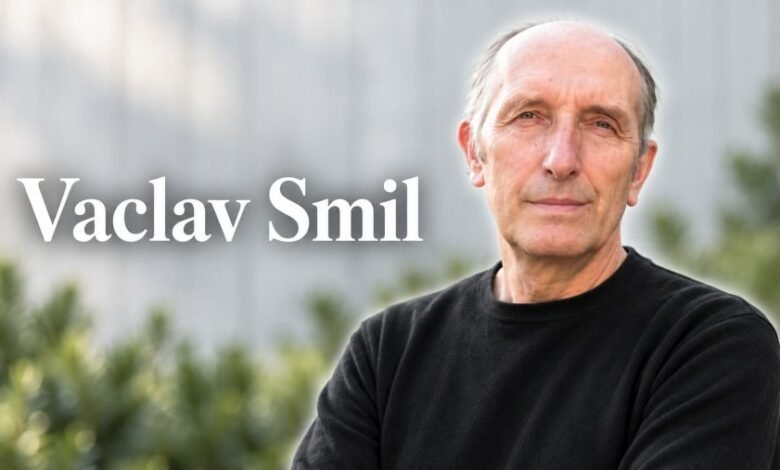
Vaclav Smil is a Czech-born Canadian scientist, author and Distinguished Professor Emeritus at the University of Manitoba. He is best known for research on energy, food systems, population, environmental change and the history of technology.
His work has a clear pattern. Check the numbers first. Look at physical limits. Then ask whether a bold promise can actually happen at the scale people claim.
As of September 2026, Smil remains professionally active. His official website says he had published 51 books and more than 500 papers by January 2026. His latest US book, Speed: How It Explains the World, was released on June 2, 2026.
Quick Facts
| Fact | Verified Detail |
|---|---|
| Full name | Vaclav Smil / Václav Smil |
| Born | December 9, 1943 |
| Birthplace | Plzeň, present-day Czech Republic |
| Profession | Scientist, researcher and author |
| Main fields | Energy, environment, food, population and technology |
| University | University of Manitoba |
| Current title | Distinguished Professor Emeritus |
| Major honour | Member of the Order of Canada |
| Academic honour | Fellow of the Royal Society of Canada |
| Published work | 51 books and 500+ papers by January 2026 |
| Latest US book | Speed: How It Explains the World |
Who Is Vaclav Smil?
Vaclav Smil studies big systems.
Energy is one example. Food is another. He has also written about population, manufacturing, transport, materials, innovation, environmental change and economic growth.
That range matters. Smil rarely treats one problem alone. A shift in energy use can require new mines, factories, transmission networks, machines and huge amounts of material. Food production depends on energy, fertilizer, land and transport. Technology has limits too.
Basically, he asks hard questions.
How much energy is required? How much material is needed? How long did similar changes take before? Can a proposed solution work across billions of people?
His official site describes his research as covering energy, environment, population, food, technical advances, growth, innovation, size, speed and efficiency.
Early Life and Education
Smil was born in 1943.
He grew up in Czechoslovakia. Between 1960 and 1965, he studied at Charles University in Prague. His studies covered subjects tied to energy and environmental research, including biology, geology, meteorology, demography, economics and statistics.
His student work already looked familiar.
His undergraduate thesis examined the environmental effects of coal-fired electricity generation, with particular attention to air pollution. That came years before energy and environmental questions became central parts of public debate.
Political events then changed his path.
After the Soviet-led invasion ended the Prague Spring period, Smil and his wife left Czechoslovakia. They reached the United States in August 1969. He then studied in Pennsylvania State University’s geography department, where his doctoral work focused on global energy development.
Moving to Canada
A major change came in 1972.
The University of Manitoba offered Smil an academic position. He accepted and moved to Winnipeg. That university became the main academic base of his long career.
He later became a professor and eventually Distinguished Professor Emeritus. The University of Manitoba remains his listed academic affiliation.
He built an unusual career there.
Smil did not stay inside one narrow subject. His research moved between energy systems, agriculture, environmental science, economics, population and technical history. That broad approach became his signature.
How Vaclav Smil Became Known
Smil’s reputation grew through books.
His early published work included studies of China’s energy system. Later books examined global energy use, food production, fertilizer, industrial materials, technological change and the physical systems that support wealthy societies.
His writing often starts with numbers.
Then comes scale.
A proposed technology might work technically. Smil wants to know whether it can replace existing infrastructure across whole countries. A process may save energy in one machine, but he asks what happens after millions of people use it.
That style helped make him influential among scientists, policymakers and readers interested in energy policy.
Major Books and Research
Smil has written across several decades.
Energy and Civilization: A History looks at the link between human societies and the energy sources they use. Growth: From Microorganisms to Megacities studies patterns of growth across natural and human systems.
Numbers Don’t Lie brought shorter data-based explanations to a wider audience. How the World Really Works, published in 2022, became one of his best-known general-reader books. It examines energy, food, materials and the physical foundations of daily life.
Then came more.
Invention and Innovation and Size appeared in 2023. How to Feed the World followed, with the US edition published in March 2025.
Speed: His Latest Major Book
Smil kept writing into 2026.
The US edition of Speed: How It Explains the World was published on June 2, 2026. The book examines speed across evolution, living organisms, transport, industry, technology and energy change.
The topic fits his earlier work.
Smil often questions assumptions that physical systems can change as quickly as software, electronics or public targets suggest. Speed gives him a way to compare very different rates of change across nature and human society.
His official website was still posting publication news in September 2026, including new translations of his books.
So his emeritus title does not mean his writing career has stopped.
His View of Energy Transitions
This is where debate starts.
Smil accepts the need to cut dependence on fossil fuels, but he is sceptical of timelines that ignore infrastructure, materials, industrial capacity and rising global energy demand.
His basic argument is physical.
Power plants take time. Grids take time. Mines take time. Steel, cement, transport and fertilizer systems cannot simply disappear because a target date has been announced.
In a 2024 profile, his position was described as sceptical of claims that global decarbonisation can happen on some commonly promoted schedules.
The key point is simple.
Questioning the timetable is different from rejecting the need for change.
Critics see that approach differently.
Some clean-energy advocates think Smil gives too much weight to historical rates of change and too little weight to falling technology costs and faster renewable deployment.
That disagreement has made him a regular reference point in arguments about energy policy.
Awards and Recognition
Smil holds major Canadian honours.
He is a Fellow of the Royal Society of Canada, where he is listed in the Academy of Sciences with expertise connected to energy, environment and the history of technical advances.
He is also a Member of the Order of Canada. The honour was awarded in 2013, and he was invested in 2014.
The citation recognised his work explaining how energy use affects the biosphere through his writing, teaching and public speaking.
These awards fit his career.
His work sits between science and policy. He deals with technical data, but many of his questions affect everyday decisions about food, transport, energy and economic growth.
Personal Life
Smil keeps a low public profile.
He met his wife while both were students. She was studying medicine. They left Czechoslovakia together in 1969 before he continued his studies in the United States.
He has spoken more openly about interests.
Classical music is one. Reading is another. He also enjoys cooking, including Japanese food, and has said that ideas can come while walking, reading or cooking.
He is also highly multilingual. In a 2024 interview, Smil said he was fluent in four languages and had studied about half a dozen others.
Why His Work Gets Attention
Smil does something fairly simple.
He checks scale.
That sounds basic, yet it changes many debates. A technology can work in a laboratory and still face huge barriers when deployed across a country. A cleaner machine can use less energy while total energy demand keeps rising. A new fuel can work technically but require land, minerals or infrastructure on a scale that creates another problem.
Smil keeps returning there.
Numbers first. Physical reality next.
His books often push readers away from slogans and toward measurable questions. That method explains why people with very different political and economic views still read him.
Vaclav Smil’s Current Status
As of September 2026, Smil is Distinguished Professor Emeritus at the University of Manitoba. He remains active as an author and researcher.
His official site reports 51 books and more than 500 papers by January 2026.
His recent work confirms that activity.
Speed reached US readers in June 2026. His website also reported new editions and translations during the year.
At 82 in September 2026, his publishing work still continues. His confirmed birth date is December 9, 1943.
Final Thought
Vaclav Smil built his reputation differently.
He rarely sells easy answers. Instead, he checks energy, materials, infrastructure, history and scale before accepting a claim about the future.
That can sound sceptical. Sometimes it is.
But that is the point.
Smil’s work asks readers to separate what people hope will happen from what physical systems can realistically support. After more than five decades of research and writing, that approach still defines his public work.
FAQs
Who is Vaclav Smil?
Vaclav Smil is a Czech-born Canadian scientist, author and Distinguished Professor Emeritus at the University of Manitoba who writes about energy, food, environment, population and technology.
How old is Vaclav Smil?
He is 82 years old as of September 2026. He was born on December 9, 1943.
Where was Vaclav Smil born?
He was born in Plzeň, in present-day Czech Republic.
What is Vaclav Smil famous for?
He is best known for data-based research and books about energy systems, food production, environmental change, population and technological development.
Where does Vaclav Smil work?
He is listed as Distinguished Professor Emeritus at the University of Manitoba in Canada.
How many books has Vaclav Smil written?
His official website says he had published 51 books by January 2026.
What is Vaclav Smil’s latest book?
His latest major US release is Speed: How It Explains the World, published on June 2, 2026.
Is Vaclav Smil a member of the Order of Canada?
Yes. He was appointed a Member of the Order of Canada in 2013 and invested in 2014.