
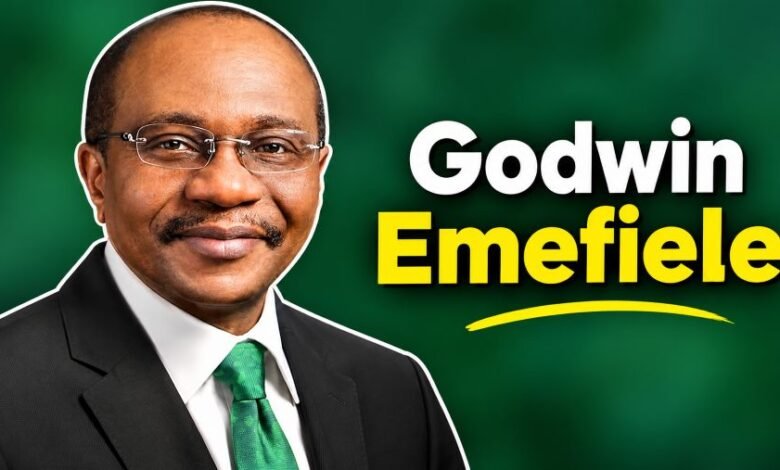
Godwin Emefiele: Age, Education, Wife, Banking Career and Latest News
The life and career of Nigeria's former Central Bank Governor, from his early teaching days and rise at Zenith Bank to major financial policies and his legal cases in 2026.

Introduction
Godwin Emefiele is a Nigerian banker and economist. He is widely known for serving as Governor of the Central Bank of Nigeria (CBN) from 2014 to 2023.
His banking career started long before that. He worked as a university lecturer, joined the commercial banking sector and later became Chief Executive Officer of Zenith Bank.
Then came his CBN appointment.
His years at the central bank brought major economic decisions. Some received support. Others faced strong criticism, particularly the naira redesign and foreign exchange policies.
Today, his public story also includes ongoing legal proceedings. Here is what the confirmed records say about his life, career and recent developments.
Quick Facts About Godwin Emefiele
| Details | Information |
|---|---|
| Full Name | Godwin Ifeanyi Emefiele |
| Date of Birth | 4 August 1961 |
| Age | 65 years (as of November 2026) |
| Birthplace | Lagos, Nigeria |
| State of Origin | Delta State, Nigeria |
| Nationality | Nigerian |
| Profession | Banker and Economist |
| Known For | Former Governor of the Central Bank of Nigeria |
| University | University of Nigeria, Nsukka |
| Education | B.Sc. in Banking and Finance, MBA in Finance |
| Former Employer | Zenith Bank Plc |
| Zenith Bank Position | Group Managing Director and CEO |
| CBN Governorship | June 2014–September 2023 |
| Wife | Margaret Emefiele |
| Children | Two, according to published profiles |
| National Honour | Commander of the Order of the Federal Republic (CFR) |
| Current Status | Former CBN Governor |
Early Life and Background
Godwin Ifeanyi Emefiele was born on 4 August 1961 in Lagos, Nigeria.
His family roots are in Delta State. He spent his early years in Lagos, where he also received his primary and secondary education.
Banking became his professional path, but he did not enter the industry immediately.
He started with teaching.
That early academic experience came before his work in major Nigerian financial institutions. It also gave him a formal background in finance and insurance.
Public information about his childhood remains limited. There are no reliable, detailed accounts of his everyday family life while growing up.
What is clear is his educational record, which later helped him enter the banking sector.
Education and Academic Qualifications
Education was an important part of his early career.
He attended Government Primary School in Lagos, formerly associated with Ansar-U-Deen Primary School, and completed his primary education in 1973.
He then attended Maryland Comprehensive Secondary School in Ikeja, Lagos.
He completed his secondary education in 1978.
Next came university.
In 1984, he earned a Bachelor of Science degree in Banking and Finance from the University of Nigeria, Nsukka.
He continued his studies at the same institution and obtained a Master of Business Administration in Finance in 1986.
According to a Central Bank publication, he received the Best Graduating Student Award in his MBA programme.
He later attended executive education courses at Harvard University, Stanford University and the Wharton School.
These were professional development courses, rather than separate university degrees.
He also received an honorary doctorate in Business Administration from the University of Nigeria.
His educational record shows a consistent interest in financial management, banking and economic decision-making.
Teaching Career Before Banking
Many people know him as a banker. Fewer know about his teaching background.
Before joining the banking industry, he taught at two Nigerian universities.
He worked at the University of Nigeria, Nsukka, teaching finance-related subjects.
He also held a teaching appointment at the University of Port Harcourt, where his work covered insurance.
This was his first professional chapter.
He later left academic teaching and entered commercial banking, where he spent more than two decades before his CBN appointment.
Early Banking Career
His commercial banking career began in 1987.
He worked with Nigerian-American Merchant Bank and gained experience in corporate banking.
He later worked at Industrial Bank Limited.
In 1990, he joined Zenith Bank as one of its founding employees.
That decision became a major turning point.
Zenith Bank was still building its business. Over the following years, he worked across several departments and took on senior management responsibilities.
His experience covered corporate banking, treasury operations, financial control and strategic planning.
He gradually moved into executive leadership.
By 2001, he had become Deputy Managing Director.
The next big appointment came in 2010.
Career at Zenith Bank
His time at Zenith Bank remains a major part of his professional record.
He joined the bank in 1990 and spent around 24 years there before moving to the Central Bank of Nigeria.
During that period, Zenith grew from a new Nigerian bank into a major financial institution with international operations.
He handled senior banking responsibilities and worked closely with the bank’s management team.
In August 2010, he became Group Managing Director and Chief Executive Officer, succeeding the bank’s founder, Jim Ovia.
This position placed him in charge of one of Nigeria’s largest commercial banks.
Zenith had established operations in several African countries and the United Kingdom during its years of expansion.
His work included overseeing banking services, managing financial operations and supporting the bank’s business strategy.
He remained CEO until his appointment to the CBN in 2014.
Appointment as Central Bank Governor
A new chapter began in 2014.
President Goodluck Jonathan nominated him for the position of Governor of the Central Bank of Nigeria in February that year.
The Nigerian Senate confirmed his appointment on 26 March 2014.
He officially assumed office on 3 June 2014.
He succeeded Sanusi Lamido Sanusi.
The appointment marked his move from commercial banking into national monetary administration.
As governor, he was responsible for leading the central bank, which oversees monetary policy, currency issuance and banking-sector regulation.
His decisions affected financial institutions, businesses and everyday Nigerians.
In 2019, President Muhammadu Buhari reappointed him for a second five-year term.
But he did not finish that term.
He was suspended in June 2023, and the CBN’s official records show that his governorship ended on 25 September 2023.
Major Policies During His CBN Career
His governorship covered a difficult period for Nigeria’s economy.
Oil-price changes, foreign exchange shortages, inflation and the COVID-19 pandemic created serious financial pressures.
The CBN introduced several policies under his leadership.
Some focused on local production. Others addressed currency management and digital payments.
Anchor Borrowers’ Programme
The Anchor Borrowers’ Programme began in November 2015.
Its main purpose was to help smallholder farmers gain access to financing and agricultural inputs.
It also aimed to connect farmers with companies that buy agricultural products.
Rice production was one of its main areas of attention.
The programme became a major part of the CBN’s agricultural financing work.
Still, questions emerged about loan repayment, oversight and its actual economic results.
Foreign Exchange Policies
Foreign exchange management was another major issue.
The CBN restricted access to official foreign exchange for certain imported products.
The stated aim was to encourage more domestic production and reduce pressure on Nigeria’s foreign reserves.
But businesses faced difficulties getting foreign currency.
Critics argued that the restrictions and multiple exchange rates created uncertainty for investors and importers.
The measures remained controversial throughout his governorship.
Introduction of the eNaira
In October 2021, Nigeria launched the eNaira.
It was a central bank digital currency issued by the CBN.
The goal was to provide another way for people and businesses to make digital payments.
The project also aimed to support financial inclusion and electronic transactions.
It was one of the most visible technology-related projects introduced during his time at the central bank.
Naira Redesign Policy
The naira redesign became one of the most widely discussed decisions of his career.
In 2022, the CBN announced redesigned versions of the ₦200, ₦500 and ₦1,000 banknotes.
The policy was intended to bring more currency into the formal banking system and address concerns about cash held outside banks.
But the transition was difficult.
Many Nigerians struggled to access cash during the early months of 2023.
Long bank queues and payment problems affected everyday business activity.
The policy faced public criticism and legal challenges.
It also became a major issue during Nigeria’s 2023 election period.
Suspension and Departure From the CBN
On 9 June 2023, President Bola Tinubu suspended Emefiele from office.
The suspension followed the start of the new presidential administration.
He was subsequently detained by Nigeria’s Department of State Services.
Legal proceedings followed, involving allegations connected to his period in public office.
Folashodun Shonubi served as acting CBN Governor after the suspension.
Olayemi Cardoso later became the substantive governor.
The Central Bank’s official historical record lists 25 September 2023 as the end of his tenure.
His departure closed nearly nine years at the head of Nigeria’s central bank.
Godwin Emefiele Latest News and Court Cases in 2026
As of 14 November 2026, he remains involved in legal proceedings arising from allegations connected to his time at the CBN.
One major case is being heard at the Lagos State Special Offences Court in Ikeja.
The Economic and Financial Crimes Commission brought 19 charges against him, including allegations relating to gratification, corrupt demands and abuse of office.
His co-defendant, Henry Omoile, faces separate allegations concerning the unlawful acceptance of gifts.
Both men have pleaded not guilty.
On 13 November 2026, the court admitted a certified copy of a Supreme Court judgment concerning an earlier asset-forfeiture case.
The earlier judgment involved the forfeiture of seven properties, approximately $2.045 million and share certificates linked to the former governor.
Justice Rahman Oshodi ruled that the certified judgment could be admitted as a public document.
However, the court also restricted how the judgment could be used.
It could establish what the Supreme Court had decided in the earlier forfeiture proceedings, but could not itself prove criminal guilt in the ongoing trial.
That distinction matters.
An asset-forfeiture judgment is not automatically a criminal conviction.
The trial was adjourned to dates in December 2026 and January 2027 for further proceedings.
As of the latest reports reviewed on 14 November 2026, these criminal allegations have not been established as convictions in the ongoing Lagos trial.
Godwin Emefiele Wife and Family
Godwin Emefiele’s wife is identified in published profiles as Margaret Emefiele.
A 2014 biographical profile reported that the couple had two children.
However, detailed public information about their children is limited.
Their names, ages and professional activities cannot all be confirmed through reliable sources.
The former governor has generally kept much of his private family life outside his official career record.
For that reason, personal details reported without dependable evidence should be treated with care.
Godwin Emefiele Net Worth and Salary
Questions about his wealth often appear online.
But there is a problem.
His exact personal net worth has not been established through reliable public financial records.
Some websites publish estimated figures, though these amounts lack sufficient evidence.
His total personal salary and benefits during his CBN tenure are also not reliably documented in the sources reviewed.
Court reports sometimes mention large financial amounts.
Those figures relate to particular allegations, transactions or forfeiture proceedings. They should not be treated as an estimate of his personal wealth.
For now, there is no dependable figure for his net worth in 2026.
Awards and Professional Recognition
His career has included national honours and professional recognition.
He received the Commander of the Order of the Federal Republic honour, commonly written as CFR.
He has also been recognised by the Chartered Institute of Bankers of Nigeria.
His academic recognition includes an honorary doctorate in Business Administration from the University of Nigeria, Nsukka.
These honours form part of his public professional record.
They sit alongside a banking career that began in the late 1980s and continued into senior national financial leadership.
Godwin Emefiele Career Timeline
| Year | Career Event |
|---|---|
| 1961 | Born on 4 August |
| 1978 | Completed secondary education |
| 1984 | Earned B.Sc. in Banking and Finance |
| 1986 | Completed MBA in Finance |
| 1987 | Began commercial banking career |
| 1990 | Joined Zenith Bank |
| 2001 | Became Deputy Managing Director |
| 2010 | Became Zenith Bank CEO |
| 2014 | Appointed CBN Governor |
| 2015 | Anchor Borrowers’ Programme introduced |
| 2019 | Reappointed for a second term |
| 2021 | CBN launched the eNaira |
| 2022 | Naira redesign announced |
| 2023 | Suspended and replaced as CBN Governor |
| 2026 | Continued to face legal proceedings |
Final Thought
Godwin Emefiele spent decades working in Nigeria’s financial sector.
He moved from university teaching into commercial banking, became CEO of Zenith Bank and later led the country’s central bank.
His time at the CBN brought major policy changes. Some aimed to support agriculture and local businesses, while others created serious debate.
His legal cases remain an important part of the public record.
The final legal outcomes must be judged through court decisions, not rumours or assumptions.
For now, his career stands as a major chapter in Nigeria’s recent banking and economic history.
Frequently Asked Questions
1. Who is Godwin Emefiele?
He is a Nigerian banker and economist who served as Governor of the Central Bank of Nigeria from 2014 to 2023. He previously worked as CEO of Zenith Bank.
2. How old is Godwin Emefiele in 2026?
He is 65 years old. He was born on 4 August 1961.
3. Where is Godwin Emefiele from?
He was born in Lagos, Nigeria, and his family originates from Delta State.
4. Who is Godwin Emefiele’s wife?
His wife is Margaret Emefiele, according to published biographical profiles.
5. How many children does Godwin Emefiele have?
A published 2014 profile reported that he has two children. Their private details are not fully documented.
6. What university did Godwin Emefiele attend?
He attended the University of Nigeria, Nsukka, where he earned a bachelor’s degree in 1984 and an MBA in 1986.
7. When did Godwin Emefiele become CBN Governor?
He officially assumed office on 3 June 2014 after his nomination by President Goodluck Jonathan and confirmation by the Nigerian Senate.
8. Why did Godwin Emefiele leave the CBN?
President Bola Tinubu suspended him in June 2023. His officially recorded tenure ended in September 2023, and another governor was appointed.
9. What is Godwin Emefiele’s net worth?
His exact net worth is not publicly verified. Online estimates should not be treated as confirmed financial information.
10. What is the latest news about Godwin Emefiele?
On 13 November 2026, a Lagos court admitted a Supreme Court asset-forfeiture judgment in his ongoing trial. The judge restricted its use, making clear that it could not itself establish criminal guilt.