

Your portfolio started with one buy-to-let. Now there are six properties, a business partner and a development project on the horizon. Professional business structuring services can help you decide whether one limited company, separate property companies or a holding company suits you best. A group structure isn’t automatically better, though. The answer depends on your finances, your ownership arrangements and where you want the portfolio to be in ten years.
What is a holding company?
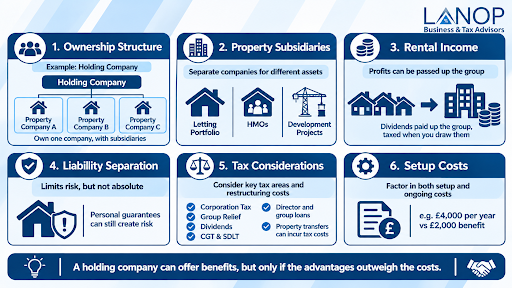
Holding companies hold shares in other companies. They are known as the parents. The companies that are held are known as the subsidiaries, and in property are often known as SPVs (special purpose vehicles). They are created to hold certain assets.
Let’s say we have a landlord called Sam. He has a holding company which owns three subsidiaries. One for family letting, one for HMOs and one for development. Each subsidiary will be a separate legal entity and have their own assets, liabilities and accounts.
One company, several SPVs or a group?
| One
company |
Separate
SPVs |
Holding company +
SPVs |
|
| Admin | Lowest | Higher | Highest |
| Risk separation | Limited | Better | Better |
| Flexibility | Moderate | High | High |
Single company structure is the easiest option for many landlords. However, all properties are exposed to the same liabilities.
Multiple SPVs will isolate risk. However, each SPV will have individual accounts and filing requirements. Having a holding company will allow you to have one owner and make it easier to attract investment and/or reinvest profits. This structure is the most complex.
When does a holding company make sense?
There are several reasons this may be the case:
-
As the portfolio grows.it becomes difficult to manage different geographical areas, sources of income and acquisitions under one company.
-
Diverse investment types. Long term lets, HMOs and developments offer different risks and many investors will separate these investments.
-
Different investors. a new investor can invest in one subsidiary but not the rest of the portfolio.
-
Reinvestment. profits can be passed back up to the parent company who can use this to fund new investments.
-
Family owned. different share classes mean voting rights are separated from income rights. However having a holding company will not automatically reduce Inheritance Tax.
When is it not worth the cost?
If you have 3 simple rental properties and are not planning on growing your portfolio, or you take the majority of the profits out yourself or your mortgage company doesn’t like multiple layers, then you probably don’t need one.
Your goals, funding and tax position are more important than the number of properties. If you’re spending more than you’re saving through restructuring then there is no point.
What about tax?
Just because you have a group structure doesn’t mean you’ll get a tax benefit.
Corporation Tax. companies pay 19% tax on profits up to £50k and 25% tax on profits above £250k for 2026/27. There will also be marginal relief. If you have associated companies the profits will be subject to the same limits. However, if you have two associated companies, the profits limit for each company will be reduced to £25k. Any further companies won’t increase the profits limits further.
Group relief. Companies in a 75% group can sometimes claim to surrender their qualifying losses to profitable members of the group. Not all losses will qualify.
Dividends. Generally qualifying dividends from your subsidiary to the parent company will be exempt from corporation tax. You will have to pay personal tax if you take money out of the company.
Capital Gains Tax/Stamp Duty Land Tax. Depending on the facts, if you transfer properties between companies you may get liable to Capital Gains Tax and Stamp Duty Land Tax. Generally, to claim Incorporation relief (Section 162), you need to have a real business transfer rather than an investment portfolio. You may be able to claim group relief under SDLT if transferring between qualifying group companies. However, this can be clawed back if a company leaves the group within three years. Scotland and Wales have their own property taxes.
Company loans. Often there will be money moving around in your group, this could include director’s loans or loans between parent and subsidiary. Ensure you document all of these. Decide if you want to charge interest. If you don’t document these loans you can cause awkward tax and accounting issues later.
Can you add a holding company to an existing company?
Often yes. Simply create a new holding company and do an equity swap to acquire the shares in your existing property company. There may be tax benefits and/or HMRC approval so do think about this first.
As far as transferring the actual properties then this will incur CGT, SDLT, valuations and lender approval. Often people get this wrong which can be costly!
Prior to restructuring make sure you know:
- Ownership of the current company.
- Valuation of properties.
- Mortgage terms and any personal guarantees.
- Director’s loans.
- Potential CGT and SDLT liability.
- If you have plans to sell or take on partners.
Does it protect your assets?
Issues for one company are typically separated. If Property A Ltd who own the HMO have issues then Property B Ltd with 2 rental properties will usually be out of reach.
This is not the case however if there are personal guarantees, intra-group security or director issues. Other assets can get dragged into the issue. The holding company will limit the company risk but you are still risking your personal guarantees.
What will lenders say?
Lenders will have different views on this. Some will be very happy, whilst others will like it kept simple. If the company has an existing mortgage then you may need the permission of the lender to change the ownership structure and there may be early repayment charges if you refinance. It is always best to ask first!
What does it cost?
You will have the initial costs of setting up, legal documentation and tax advice. You will also need to pay for your annual accounts, corporation tax returns, bookkeeping and Companies House returns. Consider these ongoing costs and compare them with the long-term benefits of having a structure in place. If you are spending £4000 per annum on a structure that only saves you £2000 from friction, then it is not a good deal.
Getting advice before you restructure
Getting it right at the outset can reduce costs. A good business structuring service will look at ownership currently, compare the three structures, look at the CGT, SDLT and corporation tax implications as well as your lenders position. We will also look at how money will move between your companies. Lanop offers Group Structuring & Holding Company Services. While we cannot guarantee any tax saving, we can advise if a group is right for you.
Frequently asked questions
Do I need a holding company to own multiple rental properties?
Not necessarily. A single limited company can be used to own multiple properties, this is often sufficient.
Is a holding company more tax efficient than a single limited company?
This depends on your profit levels, company rules and how you withdraw the money.
Can I place my existing property company into a holding company?
Often yes, a share for share exchange will allow you to move your properties into a holding company. Be aware of how the tax implications will work and any mortgage agreements.
Will mortgage lenders be happy to have a holding company over SPV?
This will depend on your lender. We would recommend asking them if they are happy with the structure, whether they want personal guarantees and how this will affect any future refinancing.
Can a holding company protect my rental properties?
They can offer some protection by keeping debts within individual companies. However, this can be undermined by personal guarantees and cross guaranteeing.
Conclusion
Creating a holding company can provide clarity on ownership of an expanding property portfolio. However, consideration should be given to taxation, lender restrictions and costs. The structure should be based upon your own aspirations. Talking to an advisor who provides business structuring services will help you to get the correct facts in front of you when making any changes to company/property ownership.
Lanop Business & Tax Advisors can help UK landlords and property investors to assess their current structure and decide if a group structure is right for them. Contact us before any changes are made to any properties or shares.