Zecway: The AI Platform Changing How Teams Find Information
A closer look at Zecway, its AI-powered workplace search, key features, security approach, pricing, and what businesses should know in 2026.

Introduction
Finding a single document at work shouldn’t feel like solving a mystery. Yet many employees spend valuable time switching between emails, shared folders, chat messages, and project management tools just to locate one important piece of information.
That’s the problem Zecway wants to solve.
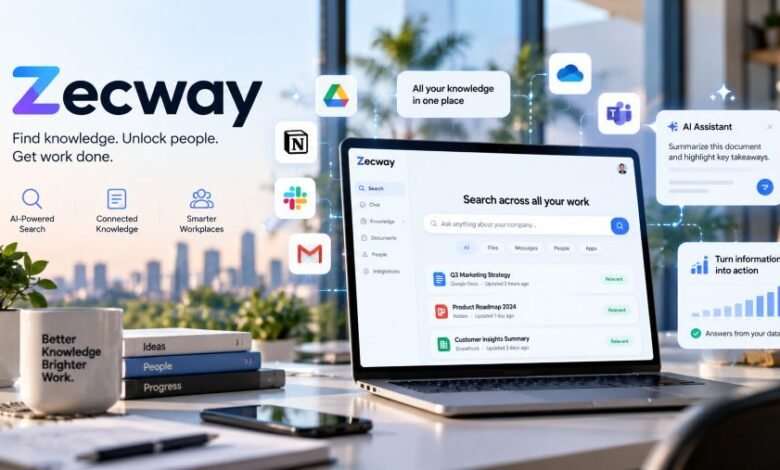
Zecway is an emerging AI-powered workplace knowledge platform designed to help companies search across their internal information from one place. Instead of opening several applications, employees can ask a question in everyday language and receive an answer supported by relevant company documents.
The idea sounds simple. But there’s more to it.
The platform also introduces plans for AI assistance, source-backed responses, and automated business tasks. As of October 2026, Zecway is promoting an early-access programme rather than a fully documented, generally available commercial service.
Quick Facts About Zecway
| Detail | Information |
|---|---|
| Name | Zecway |
| Website | www.zecway.com |
| Industry | Artificial Intelligence and Software Development |
| Main Purpose | Workplace Search and Knowledge Management |
| Headquarters Listed | Bengaluru, Karnataka, India |
| Company Profile Founded | 2026 |
| Main Technology | AI-Powered Enterprise Search |
| Target Audience | Teams of approximately 30–500 employees |
| Key Features | Unified Search, Source Citations, Permission Controls |
| Current Availability | Limited Early Access |
| Public Subscription Pricing | Not Announced |
| Credit Card for Early-Access Request | Not Required |
Company information and product positioning are based on its publicly available website and LinkedIn description as of October 2026.
What Is Zecway?
Zecway is a business software platform built around one central idea: employees should be able to find company information without searching every application separately.
Think about a typical office.
A sales presentation might be stored in Google Drive. Customer feedback could be sitting in Slack. Meeting notes may be written in Notion, while important contract discussions remain buried in email conversations.
All that information belongs to the company. But finding it isn’t always easy.
Zecway aims to connect these scattered sources through a shared search experience.
Employees can enter questions using normal language rather than remembering exact document titles or folder locations.
For example, someone might ask:
“Where is our latest pricing presentation?”
The system is designed to locate relevant information and provide an answer with references to the original materials.
Its stated goal is to reduce unnecessary searching and help employees access knowledge already available within their organisation.
How Does the Platform Work?
The platform describes three main layers: workplace search, AI assistance, and automated agents.
Each has a different purpose.
1. Centralised Workplace Search
The first layer focuses on finding information across connected company applications.
Rather than opening several systems individually, employees would search through one interface.
The company mentions integrations involving Google Drive, Slack, Notion, and email.
This approach could be especially useful for organisations handling large numbers of documents, conversations, and internal reports.
Zecway advertises answers in approximately 0.4 seconds.
However, that figure comes from the company’s marketing materials. Independent testing is not currently sufficient to confirm whether the same speed applies across different organisations and workloads.
2. AI Assistance Based on Company Data
Finding a document is useful.
Understanding its contents can save even more time.
The platform’s AI assistant is intended to help employees prepare summaries, draft responses, and work with information retrieved from authorised company sources.
Imagine a customer service employee preparing a response about a company’s refund policy.
Instead of manually reading several policy documents, an AI assistant could help prepare an initial response using the relevant information.
The employee would still need to review the answer before sending it.
Zecway describes this assistant functionality as part of its developing product offering, so businesses should verify which capabilities are available during early access.
3. Automated AI Agents
The third layer introduces AI agents intended to perform certain workplace tasks.
Unlike a search tool that only retrieves information, an agent may be designed to complete a sequence of actions.
For example, a business might want an automated system to:
- Research updates from internal sources.
- Prepare a weekly project summary.
- Identify outstanding questions.
- Draft a message for the team.
- Request approval before posting an update.
Zecway’s website describes scheduled work and human-approved actions as part of its agent concept.
The exact level of automation available to early-access customers should be confirmed through a product demonstration.
Main Features Businesses Should Know
Several features help explain the platform’s approach to workplace knowledge.
Search Across Multiple Applications
The most obvious benefit is having one location for searching information stored across supported tools.
This could help teams that frequently move between documents, chat platforms, and email accounts.
However, the usefulness of this feature depends on which integrations are actually supported and how reliably they work.
Answers With Source References
Zecway promotes responses that include citations to the documents or messages supporting an answer.
This matters.
An AI-generated statement can sound convincing while still being incorrect.
Source references give employees a way to inspect the original information before making decisions.
For businesses working with contracts, finance records, or company policies, being able to check the supporting material is particularly valuable.
Permission-Based Access
Not every employee should have access to every document.
Financial records, salary information, confidential contracts, and private company discussions often require restricted access.
Zecway states that its system applies permissions before information reaches the AI.
In principle, that means an employee should receive only the information they are authorised to access.
It’s an important design claim, although organisations should verify access controls through technical testing rather than relying entirely on marketing descriptions.
Natural Language Questions
Traditional file searches often work best when users remember keywords or filenames.
An AI-powered approach allows employees to ask conversational questions.
A project manager could ask which version of a document is current or where an earlier decision was discussed.
Whether the system can answer accurately will depend on the quality, freshness, and accessibility of the underlying information.
Assistance With Everyday Work
The platform’s broader plans extend beyond searching.
Drafting reports, summarising company material, and preparing routine communications are among the activities it intends to support.
These functions may become valuable for teams dealing with repetitive information-heavy tasks.
Who Is the Software Designed For?
Zecway’s public company description identifies organisations with approximately 30 to 500 employees as its intended audience.
That makes sense for a workplace search product.
As companies grow, their information becomes harder to manage. Different departments use different tools, and employees cannot always remember where important decisions were recorded.
Potential users include:
Operations teams: Staff responsible for policies, procedures, and recurring company activities.
Sales departments: Employees searching for presentations, product details, proposals, and customer discussions.
Human resources teams: Professionals retrieving approved employee policies and internal guidance.
Project managers: Teams reviewing earlier decisions, work updates, and project documentation.
IT departments: Administrators responsible for managing access, integrations, and information security.
These are potential use cases rather than confirmed customer deployments.
Why Workplace Knowledge Management Matters
Businesses regularly invest in tools for communication, document storage, and collaboration.
But adding applications can create another problem.
Information becomes scattered.
An employee might know that an important decision was made during a meeting, yet have no idea whether the details are in an email, a document, or a chat thread.
That creates repeated questions and unnecessary delays.
A central search system could reduce some of this friction.
The benefit isn’t simply faster document retrieval. It’s also about preserving organisational knowledge when employees change roles, move departments, or leave a company.
Still, technology cannot completely solve poor information management.
If documents are outdated, duplicated, or incorrectly labelled, an AI system may struggle to identify which source is reliable.
Good recordkeeping remains essential.
Is Zecway Safe to Use?
Security is one of the biggest considerations when evaluating any software that connects to internal company information.
Zecway presents permission-aware search as a central product feature.
According to its website, permission checks take place before restricted information is made available to the AI system.
That is an encouraging design objective.
However, public claims alone do not establish whether a platform meets an organisation’s security, privacy, and compliance requirements.
Before connecting confidential business information, companies should ask about:
- Data encryption and storage arrangements.
- User authentication and access permissions.
- Whether customer data is used for AI model training.
- Data retention and deletion policies.
- Available security audits or certifications.
- Handling of personal and sensitive information.
- Incident response and support procedures.
Organisations operating in the UK or European Union should also assess applicable data protection requirements, including UK GDPR or EU GDPR where relevant.
A controlled trial using non-sensitive information is a reasonable starting point.
Is Zecway Free? Pricing and Availability in 2026
As of October 2026, the official website promotes limited early access.
Interested businesses can submit a work email address to request entry.
The website states that no credit card is required for this initial registration.
However, this does not establish that the platform will remain free.
Detailed subscription plans, enterprise pricing, seat-based costs, and long-term commercial terms have not been publicly established through the available official information.
Companies considering the service should ask about usage limits, available features, onboarding support, and any future fees before committing to a deployment.
Zecway vs Traditional Workplace Search
The main distinction is how users interact with company information.
| Feature | Traditional Search | Zecway’s Proposed Approach |
|---|---|---|
| Search Location | Often one application | Multiple connected applications |
| Search Method | Keywords and filenames | Natural language questions |
| Results | Documents and messages | Answers with cited sources |
| AI Assistance | Not always included | Part of the product direction |
| Access Permissions | Controlled by individual tools | Permission-aware retrieval |
| Task Automation | Usually separate | AI agent capabilities planned |
| Availability | Depends on the software | Limited early access |
This comparison describes the differences in product approach, not independently measured superiority.
Zecway and Zecway Studio LLP: Are They the Same?
Researching the name reveals another important detail.
Public business records identify Zecway Studio LLP, a limited liability partnership incorporated in Bengaluru, India, on 30 June 2024.
Business directory information associates that entity with business services, while older online references describe creative and marketing activities.
Meanwhile, the current website presents an AI-powered workplace knowledge platform.
The platform’s LinkedIn profile lists 2026 as its founding year.
These dates are not necessarily contradictory. A company may introduce a new product or change its business direction over time.
However, the available information does not conclusively establish the legal relationship between the current AI offering and every earlier business operating under the Zecway name.
Businesses entering a commercial agreement should confirm the contracting legal entity directly.
Potential Benefits for Growing Companies
A well-functioning internal knowledge platform could offer several practical benefits.
Less Time Searching
Employees may spend less time moving between applications when information can be found through a central interface.
Better Access to Existing Knowledge
Company documents and recorded discussions could become easier to locate, particularly for employees unfamiliar with older projects.
More Consistent Internal Answers
Source-backed responses may help employees use the same approved documents when preparing information for colleagues or customers.
Reduced Repetitive Questions
Teams may be able to answer routine questions without repeatedly interrupting colleagues.
Support for Business Processes
If its planned assistance and automation functions become available and reliable, the platform could help employees prepare recurring reports and other routine work.
These are potential benefits. Actual results would need to be measured during implementation.
Limitations Worth Considering
Early-stage software should be evaluated carefully.
Zecway presents an interesting concept, but several questions remain open.
First, independently published performance benchmarks are limited.
Second, comprehensive public information about paid subscription packages is not yet available.
Third, the product’s three layers should not be assumed to have identical levels of maturity.
Search functionality, AI drafting, and autonomous agents involve different levels of technical complexity.
Fourth, businesses need to assess whether connecting another service creates additional administrative or security responsibilities.
Finally, AI-generated answers can contain errors even when they reference real documents.
A cited source might be outdated, incomplete, or interpreted incorrectly.
Human review remains important for high-impact decisions.
How to Get Started
Businesses interested in the platform can visit the official website at www.zecway.com.
The site currently offers an early-access registration option.
Before submitting sensitive company information, interested teams should review the provider’s available terms and request details about its security practices.
A useful trial could begin with a small collection of approved documents and a limited number of employees.
Teams can then test whether the platform retrieves relevant information, respects permissions, and provides reliable source references.
Testing actual workplace questions will tell a business much more than promotional examples alone.
Final Thought
Zecway is entering a market where finding the right information can be almost as challenging as creating it.
Its approach combines company-wide search, source-backed AI responses, permission controls, and plans for task automation.
The idea has practical appeal, particularly for growing organisations managing information across several applications.
But there is a difference between a promising product direction and a proven business solution.
As of October 2026, limited early access and incomplete independent testing mean companies should approach adoption with clear expectations.
For teams struggling with scattered knowledge, Zecway may be worth investigating. The deciding factor will be how reliably it handles real documents, real employees, and real business questions.
Frequently Asked Questions
1. What is Zecway?
Zecway is an AI-powered workplace knowledge platform designed to help employees search company information across connected applications using natural language.
2. What is Zecway used for?
It is intended for finding documents, answering workplace questions, retrieving source-backed information, and eventually supporting AI-assisted business tasks.
3. Is Zecway free?
Its website offers an early-access registration process without requiring a credit card. Public information does not establish permanent free usage or detailed subscription pricing.
4. Where is Zecway based?
The company’s LinkedIn profile lists Bengaluru, Karnataka, India, as its headquarters.
5. Does Zecway support Google Drive and Slack?
The company’s public description mentions Google Drive, Slack, Notion, and email. Businesses should confirm which integrations are available during onboarding.
6. Can Zecway access private company documents?
Its intended functionality involves accessing authorised company information through connected systems. The provider states that permission checks restrict access, but organisations should test these protections.
7. Can Zecway automate tasks?
AI agent functionality is part of its described product direction. The exact features currently available should be confirmed with the provider.
8. Is Zecway suitable for small businesses?
The company primarily targets teams of approximately 30–500 employees. Smaller organisations may also find the concept useful, depending on their software, information volume, and budget.