
Alan Duncan: The Former UK Minister Who Spent 27 Years in Parliament
From oil trading and Oxford University to British politics, foreign affairs, his partner James Dunseath, and life after Parliament.

Introduction
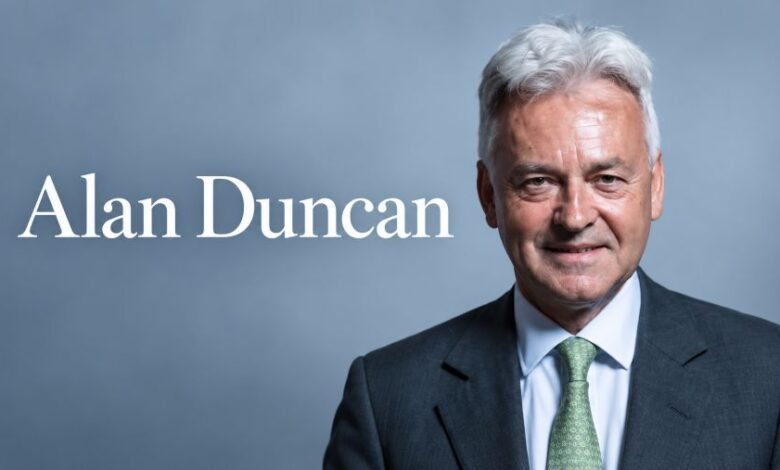
Alan Duncan is a former British Conservative politician, businessman, and author. He served as the Member of Parliament for Rutland and Melton from 1992 to 2019. During those 27 years, he worked under several Conservative leaders and held two senior government ministerial posts.
His career started far from Westminster.
Before entering Parliament, he worked in international oil trading. Later, he became Minister of State for International Development and then Minister of State for Europe and the Americas.
He also made political history in 2002. That year, he became the first serving Conservative MP to publicly acknowledge that he was gay.
His years in government were busy. They were sometimes controversial, too. His relationship with Boris Johnson, his views on foreign policy, and his published political diaries have all attracted public attention.
Quick Facts About Alan Duncan
| Detail | Information |
|---|---|
| Full Name | Sir Alan James Carter Duncan |
| Popular Name | Sir Alan Duncan |
| Date of Birth | 31 March 1957 |
| Age | 69 years (as of October 2026) |
| Birthplace | Rickmansworth, Hertfordshire, England |
| Nationality | British |
| Profession | Former politician, businessman, author |
| Political Party | Conservative Party |
| Education | University of Oxford and Harvard University |
| Former Constituency | Rutland and Melton |
| Parliamentary Career | 1992–2019 |
| Partner | James Dunseath |
| Civil Partnership | July 2008 |
| Known For | British politics and foreign affairs |
| Honour | Knight Commander of the Order of St Michael and St George |
| Notable Book | In the Thick of It (2021) |
| Current Parliamentary Status | Former MP |
Early Life and Background
Alan James Carter Duncan was born on 31 March 1957 in Rickmansworth, Hertfordshire, England.
He grew up in Britain during a period when the country’s political and economic life was changing. But his childhood was not the subject of the same public attention that his later political career received.
His early education is documented.
Detailed information about his parents, siblings, and family upbringing is not widely established through reliable public sources.
What is clear is that his academic years opened the door to international business and politics.
That journey began at school.
Education and University Years
Duncan attended Beechwood Park School in Hertfordshire. He later studied at Merchant Taylors’ School.
After finishing school, he entered St John’s College at the University of Oxford.
He studied politics and economics between 1976 and 1979.
Oxford became an important part of his life.
During his university years, he was elected President of the Oxford Union, the well-known student debating society.
The role gave him experience in public speaking, argument, and organised debate.
His education continued overseas.
In 1981, he received a Kennedy Scholarship to study at Harvard University in the United States. He remained there until 1982.
The experience added an international element to his academic background before he built his business career.
Education at a glance:
- Beechwood Park School, Hertfordshire
- Merchant Taylors’ School
- St John’s College, University of Oxford, 1976–1979
- President of the Oxford Union
- Kennedy Scholar at Harvard University, 1981–1982
His educational history is recorded in his official UK government profile.
His First Career Was in Business
Politics came later.
After completing his Oxford studies in 1979, Duncan joined Shell International.
He worked there until 1981.
In 1982, he joined Marc Rich and Co, an international commodities trading business. His work focused on oil trading, and he remained with the company until 1988.
This gave him direct experience of international energy markets.
He learned how oil supplies moved between countries and how commercial decisions could affect governments.
His next move was independent consulting.
Between 1988 and 1992, he worked as a consultant and adviser to foreign governments. His areas of work included oil supplies, shipping, and refining.
In 1989, he established Harcourt Consultants.
The business provided advice on oil and gas matters.
He developed considerable experience in the Middle East, an area that would later become important during his diplomatic career.
So, before Westminster, he already understood international commerce.
That experience helped explain his later interest in foreign affairs.
How He Entered British Politics
His first parliamentary attempt failed.
In the 1987 general election, Duncan stood as the Conservative candidate for Barnsley West and Penistone.
He did not win.
But he continued working towards a parliamentary career.
His next opportunity came in 1992.
On 9 April that year, he was elected Conservative MP for Rutland and Melton.
It began a long period in the House of Commons.
He represented the constituency through several general elections and remained its MP until 6 November 2019.
More than 27 years in Parliament gave him experience of opposition politics, government work, and major national debates.
His complete service record is available through the UK Parliament’s official career register.
Building His Career in the Conservative Party
After entering Parliament, Duncan gradually received larger responsibilities.
In 1997, he became Vice-Chairman of the Conservative Party.
He also served as Parliamentary Political Secretary to William Hague.
These roles placed him closer to the party’s senior leadership.
Over the following years, he moved through several shadow ministerial jobs.
His responsibilities included health, trade, foreign affairs, international development, transport, business, and justice.
This was a long apprenticeship.
While the Conservatives remained in opposition, he gained experience questioning government decisions and developing alternative policies.
Some of his main shadow positions included:
| Political Position | Years |
|---|---|
| Conservative Party Vice-Chair | 1997–1998 |
| Shadow Health Spokesperson | 1998–1999 |
| Shadow Trade and Industry Spokesperson | 1999–2001 |
| Shadow Foreign Affairs Minister | 2001–2003 |
| Shadow Justice and Constitutional Affairs Roles | 2003–2004 |
| Shadow International Development Secretary | 2004–2005 |
| Shadow Transport Secretary | 2005 |
| Shadow Business and Trade Roles | 2005–2009 |
| Shadow Leader of the House of Commons | 2009 |
| Shadow Minister for Prisons and Probation | 2009–2010 |
He was also associated with the Conservative Party’s leadership discussions in 2005.
He considered entering the leadership contest but withdrew before becoming a formal candidate.
Later, he continued serving on the opposition frontbench under David Cameron.
Working as International Development Minister
A major career change arrived in May 2010.
The Conservative Party entered government in coalition with the Liberal Democrats, and David Cameron became prime minister.
Duncan was appointed Minister of State for International Development on 13 May 2010.
He held the position until July 2014.
The Department for International Development worked on overseas development assistance and programmes addressing poverty, humanitarian emergencies, and economic development.
As a minister, Duncan participated in the management of Britain’s international development policy.
His experience in overseas business gave him a background in dealing with international issues.
But business and government were different jobs.
In a 2015 interview with the Institute for Government, he discussed the demands of becoming a minister and adjusting to government after years in opposition.
His comments gave readers a direct account of how ministerial work operated.
The full interview is available from the Institute for Government.
Diplomatic Work in Yemen and Oman
His work with the Middle East continued.
In August 2014, the British government appointed him Special Envoy to Yemen and Special Envoy to Oman.
These were diplomatic assignments.
The Yemen role involved supporting Britain’s policy on security, stability, and development.
His work concerning Oman focused on maintaining and strengthening relations between the UK and Oman.
He already had years of experience in the region through business and government work.
The appointments followed the end of his period as International Development Minister.
The UK government announced the roles on 4 August 2014 in an official Foreign Office statement.
Returning to Government During Brexit
In July 2016, Theresa May appointed Duncan Minister of State for Europe and the Americas at the Foreign and Commonwealth Office.
Britain had just voted to leave the European Union.
The political situation was unsettled.
Government ministers faced difficult questions about Britain’s future relationship with European countries, international trade, and diplomacy.
Duncan worked alongside senior figures at the Foreign Office, including Boris Johnson during Johnson’s time as Foreign Secretary.
The job kept him close to international discussions during a demanding period for the British government.
He remained in the ministerial post until July 2019.
Why Did He Resign in 2019?
Duncan resigned from his Foreign Office position on 22 July 2019.
His departure came shortly before Boris Johnson became prime minister.
The two politicians had worked together, but their political relationship had become strained.
Duncan had criticised aspects of Johnson’s political approach and was concerned about the direction of Brexit.
His resignation allowed him to speak more freely about the situation.
He was not leaving Parliament immediately.
However, he later decided not to contest the December 2019 general election.
His House of Commons membership ended on 6 November 2019.
Alicia Kearns subsequently became the Conservative MP for Rutland and Melton.
That closed his parliamentary career.
He had served for more than a quarter of a century.
His Partner and Personal Life
Alan Duncan’s partner is James Dunseath.
The couple entered into a civil partnership in July 2008.
Their relationship received public attention because Duncan was a senior Conservative politician at a time when openly gay MPs were less common in the party.
His earlier announcement was also significant.
On 29 July 2002, he publicly acknowledged that he was gay in an interview with The Times.
He became the first serving Conservative MP to make such a voluntary public announcement.
It was a notable moment in British political history.
Six years later, his civil partnership with James Dunseath marked another public milestone.
The couple’s partnership was reported in national newspapers, including The Guardian.
Duncan has discussed his sexuality publicly, but many other parts of his family life have remained private.
Reliable public information about children and current household arrangements is limited.
Political Views and Public Disagreements
Duncan’s career included disagreements within his own party.
He was associated with a socially liberal approach to some issues and spoke publicly about gay rights.
His views on the European Union also placed him at odds with some Conservative colleagues.
Foreign policy became another area of dispute.
He had long been interested in the Middle East, including Britain’s relationships with countries in the region.
His views concerning Israel and the Palestinians have attracted attention.
In April 2024, he criticised some Conservative politicians and groups over their positions on Israel and the Gaza conflict.
He argued that certain political relationships were influencing British policy.
Those were his allegations, not established findings against the individuals he criticised.
His comments led to a Conservative Party disciplinary investigation.
In July 2024, he was cleared following the party’s inquiry.
He then criticised how the investigation had been conducted.
The outcome was reported by The Guardian in July 2024.
The episode showed that his willingness to criticise party colleagues continued after he left Parliament.
His Books and Writing Career
Duncan has written about political ideas and his experience inside government.
His earlier work includes Saturn’s Children: How the State Devours Liberty, Prosperity and Virtue, published in 1995.
The book addresses government power and individual freedom.
But his best-known later publication is much more personal.
In the Thick of It: The Private Diaries of a Minister
Published in April 2021, In the Thick of It records his experiences during a turbulent period in British politics.
The book discusses his time in government, the Brexit years, and his relationships with political colleagues.
Boris Johnson features prominently.
The diaries offer Duncan’s personal account of events rather than an independent account agreed upon by everyone involved.
Readers can see how he viewed political meetings, disputes, and government decisions at the time.
The book was published by HarperCollins.
It attracted attention because of its direct descriptions of senior politicians.
For readers interested in his own account of government life, it is a useful primary source.
Knighthood and Honours
Duncan received a major honour in 2014.
He was appointed a Knight Commander of the Order of St Michael and St George, commonly shortened to KCMG.
The honour was announced in July 2014.
The Order of St Michael and St George is associated particularly with public service and work relating to international affairs.
Following his appointment, he became known as Sir Alan Duncan.
He also holds the title Right Honourable, reflected in his official government biography.
Public Controversies During His Career
A long parliamentary career brought difficult headlines.
In 2009, Duncan faced criticism during the parliamentary expenses controversy.
Questions were raised about claims involving gardening costs.
The issue received national media attention and became part of the broader debate about MPs’ expenses.
Later disagreements were more political.
His relationship with Boris Johnson deteriorated during the Brexit years.
He was also openly critical of certain approaches to British foreign policy.
After leaving Parliament, his comments on Israel-related political issues led to the 2024 investigation described earlier.
These events form part of his public record.
They should be understood alongside the official appointments and parliamentary work that occupied most of his political career.
His Net Worth and Business Earnings
Duncan worked in international oil trading before entering politics.
He also established an advisory business and later held public office.
These are documented career activities.
But they do not establish his current wealth.
No authoritative, publicly verified figure for his personal net worth has been established.
Online financial estimates should be treated carefully unless supported by reliable financial records.
His parliamentary financial-interest declarations provide information about particular activities and interests during his time as an MP, but they do not give a complete calculation of his personal assets.
His present income is also not reliably established through the sources reviewed.
Where Is He Now?
As of October 2026, Duncan is no longer a serving MP or government minister.
He left the House of Commons in 2019.
Since then, he has remained publicly associated with political writing, commentary, and discussions concerning British foreign policy.
His 2021 political diaries brought renewed attention to his relationship with senior Conservative figures.
The 2024 disciplinary dispute also returned him to the news.
No later government appointment or return to Parliament was confirmed in the sources reviewed for this article.
His official parliamentary record still identifies him as a former member.
Career Timeline
| Year | Career Event |
|---|---|
| 1957 | Born in Rickmansworth, Hertfordshire |
| 1976 | Began studying at Oxford |
| 1979 | Completed Oxford studies and joined Shell |
| 1981 | Began studies at Harvard |
| 1982 | Joined Marc Rich and Co |
| 1989 | Established Harcourt Consultants |
| 1992 | Elected MP for Rutland and Melton |
| 1997 | Became Conservative Party Vice-Chair |
| 2002 | Publicly acknowledged his sexuality |
| 2008 | Entered a civil partnership with James Dunseath |
| 2010 | Became Minister of State for International Development |
| 2014 | Received KCMG honour and special envoy appointments |
| 2016 | Became Minister of State for Europe and the Americas |
| 2019 | Resigned from government and left Parliament |
| 2021 | Published In the Thick of It |
| 2024 | Cleared following a Conservative Party disciplinary inquiry |
Final Thought
Alan Duncan spent decades close to British political power.
His working life took several turns. He began in the energy business, entered Parliament in 1992, and went on to represent his constituency for 27 years.
His experience in foreign affairs made him a familiar figure in government. His public relationship with James Dunseath also became part of an important period of change in British politics.
He did not always agree with his party.
That became particularly clear during Brexit and in the years after he left Westminster.
His ministerial record, public statements, and published diaries offer a detailed account of a politician whose career crossed major changes in British political life.
Frequently Asked Questions
1. Who is Alan Duncan?
Alan Duncan is a former British Conservative MP, businessman, and author. He represented Rutland and Melton from 1992 to 2019 and served in two senior government ministerial positions.
2. How old is Alan Duncan?
He is 69 years old as of October 2026. He was born on 31 March 1957.
3. Who is Alan Duncan’s partner?
His publicly known partner is James Dunseath. They entered into a civil partnership in July 2008.
4. What is Alan Duncan famous for?
He is known for his long parliamentary career, Foreign Office work, international development responsibilities, and his historic public announcement in 2002 that he was gay.
5. Where did Alan Duncan study?
He studied at St John’s College, Oxford, and later attended Harvard University as a Kennedy Scholar.
6. Why did Alan Duncan leave politics?
He resigned from his Foreign Office position in July 2019 amid political disagreements and later stood down as an MP before the December 2019 general election.
7. What is Alan Duncan’s net worth?
His current net worth has not been established through authoritative public financial records.
8. What book did Alan Duncan write?
He wrote In the Thick of It: The Private Diaries of a Minister, published in 2021. He also wrote Saturn’s Children, published in 1995.