
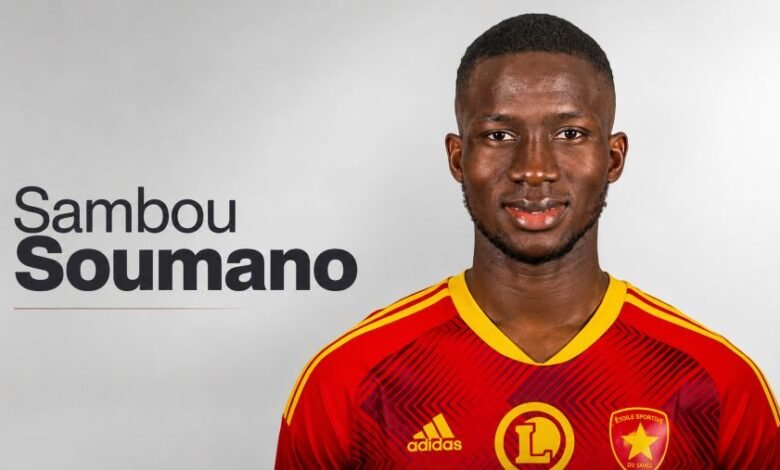
Sambou Soumano: From Tambacounda to Stade de Reims
The Senegalese striker built his career through lower-league football, calculated loan moves and an unusual record-breaking season from the Lorient bench.

Introduction
Sambou Soumano’s career does not follow the smooth path normally associated with elite football prospects. He did not arrive in Europe as a heavily promoted academy star, nor did his first Ligue 1 appearances immediately secure him a permanent starting role.
His progress came through a different route.
Born in Senegal and raised largely in Tambacounda, Soumano moved through local football schools before earning an opportunity in France. Pau FC, Châteaubriant, Lorient, Eupen, Rodez and Quevilly-Rouen Métropole all became part of his development. Some moves took him down a division. Others placed him on loan far from his parent club. Yet one theme remained consistent: Soumano repeatedly sought minutes on the pitch rather than accepting a more prestigious place on the bench.
That choice eventually produced results. He scored 12 Ligue 2 goals for QRM in 2023/24, returned to Lorient and scored 14 times during their 2024/25 promotion season, including a remarkable 10 goals as a substitute. After another season in Ligue 1, he joined Stade de Reims in July 2026 on a contract running to 2030.
At 25, Soumano is no longer simply a developing prospect. His record shows that he can score regularly in Ligue 2. The next question is whether he can turn that production into a sustained role as a first-choice striker.
Quick Facts
| Fact | Detail |
|---|---|
| Full name | Sambou Soumano |
| Nationality | Senegalese |
| Birth year | 2001 |
| Birthplace | Dakar, Senegal |
| Raised in | Tambacounda, Senegal |
| Position | Centre-forward |
| Height | Around 1.82 m |
| Preferred foot | Right |
| Current club | Stade de Reims |
| Joined Reims | July 2026 |
| Reims contract | Until June 2030 |
| Former clubs | Pau FC, Châteaubriant, Lorient, Eupen, Rodez, QRM |
| Ligue 2 goals for QRM in 2023/24 | 12 |
| Ligue 2 goals for Lorient in 2024/25 | 14 |
| Senegal senior caps | No verified senior appearances |
Birth-date note: reliable sources disagree on Soumano’s exact date of birth. FC Lorient lists 3 January 2001, while L’Équipe and several statistical databases list 13 January 2001. Because the evidence is inconsistent, January 2001 is the safest verified description.
Dakar Birth, Tambacounda Upbringing
Soumano’s football story is closely tied to Tambacounda even though he was born in Dakar.
In an interview published by France’s professional football league, he explained that he moved to Tambacounda as a baby and grew up there. Football became part of his life through local schools before his ambitions eventually took him back toward the Dakar area.
That distinction matters because short online profiles often reduce a player’s early life to a birthplace. In Soumano’s case, Dakar tells only part of the story. Tambacounda was where he spent much of his childhood and began building the football identity he would later carry to France.
As his level improved, Soumano joined Youth Elite Foot, an important step toward more structured development and greater exposure. He has credited club president Abdoulaye Niang with helping him during this stage, including providing support when Soumano moved away from his family.
The move also put him closer to the type of scouting network that could create opportunities abroad.
Pau FC Opened the Door to France
Soumano’s route into French football came through Pau FC’s connections in Senegal.
According to his account to the LFP, Pau officials saw him through scouting activities linked to Youth Elite Foot. The opportunity eventually took him from Senegal to France, where he initially had to prove himself away from the glamour of top-flight football.
His early work took place largely with Pau’s reserve side.
During the 2019/20 season, historical statistical records credit him with eight goals in 13 appearances for the reserve team. The numbers showed potential, but Soumano faced a decision familiar to many young players: remain attached to a professional club without guaranteed senior minutes, or move somewhere he could play more regularly.
He chose the second option.
Soumano later explained that Pau wanted him to continue moving between the reserve and first-team environments. He felt another reserve-heavy season would limit his progress.
That decision led him to Voltigeurs de Châteaubriant.
Châteaubriant Gave Soumano a Different Kind of Opportunity
Moving from Pau to Châteaubriant did not look like an obvious upward career move on paper.
Yet it fitted Soumano’s priorities.
Instead of remaining around a professional squad without a clear role, he entered an environment where competitive football was more accessible. Châteaubriant played in France’s lower national structure, giving him another chance to demonstrate that his scoring ability could transfer beyond reserve football.
Lorient took notice.
The Breton club brought Soumano into its system, and his scoring output with the reserves quickly created pressure for a first-team opportunity. In 2021/22, he scored 13 goals in 11 reserve appearances, according to the LFP’s profile of his career.
For a young forward, those numbers were difficult to ignore.
Soon, he was playing in Ligue 1.
Three Straight Scoring Games Announced His Ligue 1 Arrival
Soumano made 21 Ligue 1 appearances for Lorient during the 2021/22 season and scored three times.
The total itself was modest. The sequence was more memorable.
His three goals came in consecutive league matches against Lille, Nantes and Lens. For a striker who had recently been playing further down the French football structure, scoring in three straight top-flight games suggested that his development was accelerating.
But breaking into a Ligue 1 team and becoming its established striker are two very different achievements.
Soumano remained short of regular starts.
Rather than waiting indefinitely for that situation to change, Lorient and the player turned toward loans.
Eupen and Rodez Tested His Approach
Soumano joined Belgian club Eupen on loan in 2022.
The move did not develop as intended. He made seven league appearances and scored once before the arrangement ended early.
In his later LFP interview, Soumano described problems involving communication with the coaching staff and reduced playing time. Instead of staying in a situation where his role had become limited, he contacted Lorient and sought another solution.
He returned to France and joined Rodez for the second half of the 2022/23 campaign.
Soumano scored twice during that Ligue 2 loan spell. It was not yet the breakthrough season he needed, but the experience kept him in senior football.
The following loan would change his trajectory much more significantly.
QRM Became the Turning Point
Quevilly-Rouen Métropole offered Soumano something that had been difficult to secure consistently elsewhere: regular professional responsibility.
During the 2023/24 Ligue 2 season, he scored 12 league goals. He also scored three times in the Coupe de France.
The league output mattered for several reasons.
First, it demonstrated that his earlier reserve scoring record could translate into sustained senior production. Second, he was no longer contributing only in short bursts. He was producing across a full professional campaign.
By February 2024, the LFP reported him among Ligue 2’s leading scorers.
QRM’s broader season was difficult, but Soumano’s individual performance changed how his own future looked. He returned to Lorient with stronger evidence that he could handle a significant attacking role.
He also returned with a clearer philosophy.
Speaking during his QRM period, Soumano made his priorities explicit: he preferred playing regularly in Ligue 2 to spending his time on a Ligue 1 bench.
His next season showed why.
Lorient Turned Him Into Ligue 2’s Unusual Super-Sub
Lorient were competing in Ligue 2 in 2024/25 after relegation from the French top flight.
Soumano returned to the club and produced the most statistically distinctive season of his career.
He scored 14 league goals, helping Lorient win Ligue 2 and return to Ligue 1. He finished fifth among the division’s leading scorers, according to Lorient’s official season review.
Yet the total tells only half the story.
Ten of those 14 goals came after Soumano entered as a substitute.
The LFP identified that as the highest total of substitute goals by one player in a single Ligue 2 season during the 21st century.
It was an unusual record because elite goalscorers typically accumulate their numbers through regular starts and large amounts of playing time. Soumano was doing substantial damage in shorter appearances.
One of the clearest examples came against Caen in April 2025. Introduced from the bench, he scored twice as Lorient won 4–0, including a goal in stoppage time.
His season therefore created a useful distinction.
Soumano had become highly effective at changing matches. What he had not yet established was the same level of production as an undisputed week-to-week starter.
Promotion gave him another chance to test that distinction at the highest domestic level.
The Return to Ligue 1 Was More Difficult
Lorient’s promotion brought Soumano back to Ligue 1 for the 2025/26 season.
He appeared in 31 league matches, but only eight came as starts. His final league return was four goals and two assists.
Compared with his 14 goals the previous season, the decline was clear. The context, however, matters.
A raw comparison between 14 and four goals risks implying that Soumano simply became a much worse striker after promotion. In reality, he was playing in a stronger division while continuing to spend much of the season outside the starting XI.
The season therefore reinforced both sides of his record.
Soumano had already shown that he could score at a strong rate in Ligue 2. Ligue 1 remained a more demanding problem, particularly without guaranteed starts.
When his Lorient contract reached its end, the next stage of his career brought him back to the second tier.
Why Stade de Reims Signed Soumano
Stade de Reims announced Soumano’s arrival on 7 July 2026.
He joined as a free agent and signed a four-year contract running until June 2030.
Reims had a clear body of evidence to evaluate.
Across his two most recent complete Ligue 2 seasons, with QRM in 2023/24 and Lorient in 2024/25, Soumano had scored 26 league goals.
For a club looking for proven second-tier attacking output, that record carried obvious value.
The move also represented something different for Soumano personally. Previous stages of his career had frequently involved short contracts, reserve football or temporary loans. A four-year agreement gives him greater medium-term stability.
Early evidence also suggested Reims viewed him as more than a specialist substitute.
Through the club’s opening three Ligue 2 matches of the 2026/27 season, Soumano had started all three and played 198 minutes. He had not yet registered a goal or assist during that early stretch.
Three matches are far too small a sample to draw meaningful conclusions about his season, but the starting role itself is relevant. It gives him an opportunity to address one of the central questions created by his Lorient years: how productive can he be when trusted from the opening whistle rather than introduced late?
Senegal Remains an Unfulfilled International Goal
Soumano’s club career has unfolded entirely in Europe since his move to France, but representing Senegal remains part of his ambition.
As of the evidence reviewed for this profile, no senior Senegal appearance has been verified.
In a 2024 interview with Record, Soumano went further, saying that he had never represented Senegal at any age-group level.
During his productive Lorient season in 2024/25, he openly discussed earning a national-team call-up as one of his goals.
That ambition needs context.
Senegal have had considerable depth in attacking positions, making selection difficult even for forwards performing well in European leagues. Soumano’s strong Ligue 2 numbers put him into the broader conversation, but they did not automatically make him a senior international.
For that reason, descriptions of him as a “Senegal international” should be avoided unless a future official appearance changes his status.
He is a Senegalese professional footballer with international ambitions. That is the accurate distinction.
What Kind of Striker Is Sambou Soumano?
Soumano is primarily a centre-forward and is listed at around 1.82 metres.
His career statistics tell us more confidently about his effectiveness than broad stylistic labels do.
He has shown an ability to score in different contexts, particularly in Ligue 2, and his 2024/25 record proves he can have an immediate attacking impact from the bench. His development has also depended heavily on finding environments where he receives enough minutes to build rhythm.
What the evidence does not justify is portraying him as a finished elite-level striker.
His strongest sustained scoring seasons have come in France’s second tier. His Ligue 1 returns have been more limited. That difference is central to understanding where he currently stands.
He has proven one level. The higher one remains a challenge.
Soumano’s Career Is More Coherent Than It First Appears
Viewed only as a list of clubs, Soumano’s career can appear unsettled.
Pau. Châteaubriant. Lorient. Eupen. Rodez. QRM. Lorient again. Reims.
But his own explanations give those moves a clear logic.
He repeatedly sought competitive football when his route into a starting role became blocked. Leaving Pau gave him more senior exposure. Ending an unsuccessful Eupen loan opened another route in France. QRM finally provided the sustained Ligue 2 opportunity that led to a 12-goal season.
That experience then helped him produce 14 goals for a promotion-winning Lorient team.
The lesson from his career so far is not that every move worked. Eupen clearly did not. Rodez produced only limited scoring output. His return to Ligue 1 was less productive than his second-tier season.
What matters is that repeated attempts to find playing time gradually established him as a proven Ligue 2 goalscorer.
Reims now offers a different test: turning that proven scoring record into consistency and responsibility over several seasons.
Final Thoughts
Sambou Soumano has built his professional career through persistence, but the more revealing feature is how deliberately he has pursued playing opportunities.
He moved away from reserve football when he felt his development required senior minutes. He accepted loans rather than remaining on the fringes at Lorient. His best breakthrough came at QRM, where regular football produced 12 Ligue 2 goals. He then returned to Lorient and delivered an even stronger season, scoring 14 times and setting a modern Ligue 2 benchmark with 10 goals from the bench.
The limits of his record are just as important. His scoring rate fell after Lorient’s promotion to Ligue 1, and he has yet to establish himself with Senegal’s senior national team.
That combination makes the Reims chapter significant.
He is no longer being evaluated purely on potential. He has a clear track record in Ligue 2, a contract through 2030 and an opportunity to show that he can be more than an effective substitute or temporary loan striker.
For Soumano, the next stage is about converting proven goalscoring ability into a permanent leading role.
Frequently Asked Questions
Who is Sambou Soumano?
Sambou Soumano is a Senegalese professional footballer who plays as a centre-forward for Stade de Reims.
How old is Sambou Soumano?
Soumano was born in January 2001 and is 25 years old in 2026. Sources disagree over whether his exact birth date is January 3 or January 13.
Where was Sambou Soumano born?
He was born in Dakar, Senegal, but spent much of his childhood in Tambacounda.
Which club does Sambou Soumano play for?
He joined Stade de Reims in July 2026 on a contract running until June 2030.
How many goals did Sambou Soumano score for Lorient in 2024/25?
He scored 14 Ligue 2 goals as Lorient won the league and earned promotion to Ligue 1.
What record did Sambou Soumano set in Ligue 2?
Ten of his 14 league goals in 2024/25 came as a substitute. The LFP identified this as the highest single-season total of substitute goals in Ligue 2 during the 21st century.
Did Sambou Soumano play for QRM?
Yes. He spent the 2023/24 season on loan at Quevilly-Rouen Métropole and scored 12 Ligue 2 goals.
Has Sambou Soumano played for Senegal?
No senior Senegal appearance was verified in the research used for this article. Soumano has publicly spoken about wanting to earn a national-team call-up.
What position does Sambou Soumano play?
He primarily plays as a centre-forward.
Which teams has Sambou Soumano played for?
His career has included Pau FC, Voltigeurs de Châteaubriant, FC Lorient, Eupen, Rodez, Quevilly-Rouen Métropole and Stade de Reims.